Selecting the appropriate aluminium sheet thickness is an important consideration in mechanical design, aerospace engineering, architecture, and manufacturing. Choosing a sheet that is too thin can result in catastrophic structural failure under load, while over-specifying thickness adds unnecessary weight, limits formability, and inflates procurement costs.
This primer covers the technical basics of how to specify aluminium sheet thickness, compares measurement systems, discusses alloy compatibility, and provides an engineering framework to help you optimise your material choice for performance and budget.
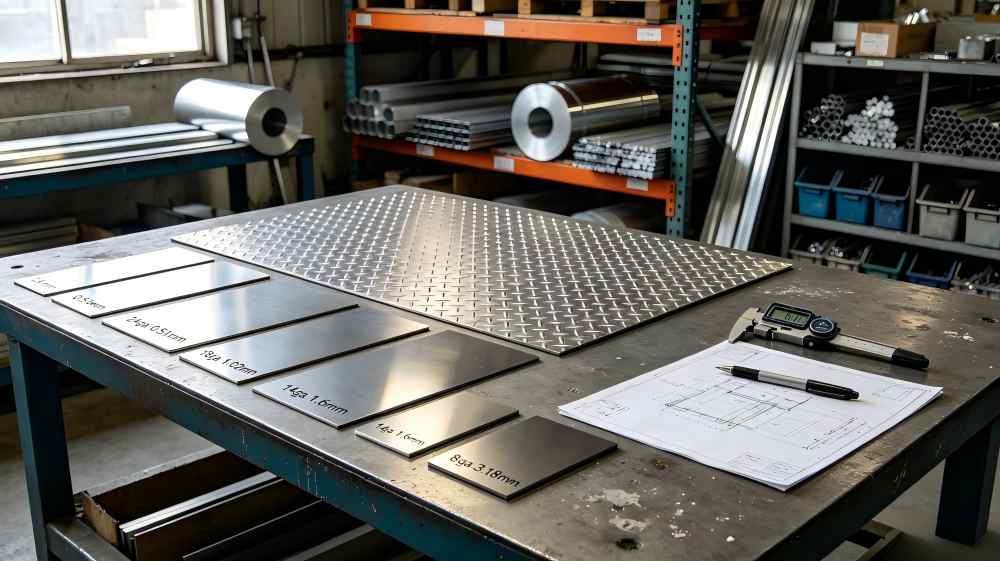
A Review of Systems for Aluminium Sheet Thickness Measurement
Engineers and buyers have to learn three different measurement systems – decimal inches, millimetres and gauges – to get material right and avoid costly drafting errors.
The Danger of the “Gauge” System in Aluminum
The Manufacturers’ Standard Gauge is commonly used to measure the thickness of a steel sheet. Aluminium is measured with the Brown & Sharpe (B&S) scale, also called the American Wire Gauge (AWG).
Critical Warning: Do not assume that a 16 gauge steel sheet is the same thickness as a 16 gauge aluminium sheet. For example, 16-gauge carbon steel is about 0.0598 inches (1.52mm) while 16-gauge aluminium is 0.0508 inches (1.29mm). Never use gauge numbers as the only dimension on engineering drawings. Always include the exact decimal inch or millimetre dimension. This prevents errors in procurement or structural integrity.
Aluminium Sheet versus Aluminium Plate
In metallurgical standards, the thickness determines the legal and technical classification of the material:
Aluminum Sheet: Material which has a thickness between 0.006 inches (0.15mm) and 0.249 inches (6.32mm). Sheets are generally cold-rolled and are often coiled.
Aluminum Plate: Material with a thickness of 0.250 inches (6.35mm) or more. Plates are hot-rolled and are used in heavy-duty structural applications requiring precision machining.
Aluminum Sheet Thickness and Application Reference Chart
The following structured dataset outlines standard industry thicknesses, their gauge equivalents, and their target engineering applications.
| Gauge (B&S / AWG) | Nominal Thickness (Inches) | Nominal Thickness (mm) | Industry Standard Applications & Use Cases |
| 24 ga | 0.020″ | 0.51mm | Precision shims, highly intricate electronic shielding, beverage cans, cosmetic foil trim. |
| 22 ga | 0.025″ | 0.64mm | Architectural flashing, HVAC ductwork facings, lightweight model making. |
| 20 ga | 0.032″ | 0.81mm | Aircraft skin panels, high-end commercial signage, heat shields, luggage shells. |
| 18 ga | 0.040″ | 1.02mm | Automotive body panels, appliance wrappers, solar panel frames, equipment dials. |
| 16 ga | 0.050″ | 1.27mm | Electronic chassis, industrial junction boxes, intermediate brackets, marine fuel tanks. |
| 14 ga | 0.063″ | 1.60mm | The Sheet Metal “Sweet Spot”: Heavy-duty toolboxes, deep-drawn parts, vehicle floor pans, robust enclosures. |
| 12 ga | 0.080″ | 2.03mm | Highway signage, trailer skins, structural bracketry, military electronics housings. |
| 11 ga | 0.090″ | 2.29mm | Heavy-duty commercial vehicle panels, material handling bins, architectural louvers. |
| 8 ga | 0.125″ (1/8″) | 3.18mm | Structural Sheet: Floor diamond plates, off-road vehicle skid plates, heavy machinery guards, marine hulls. |
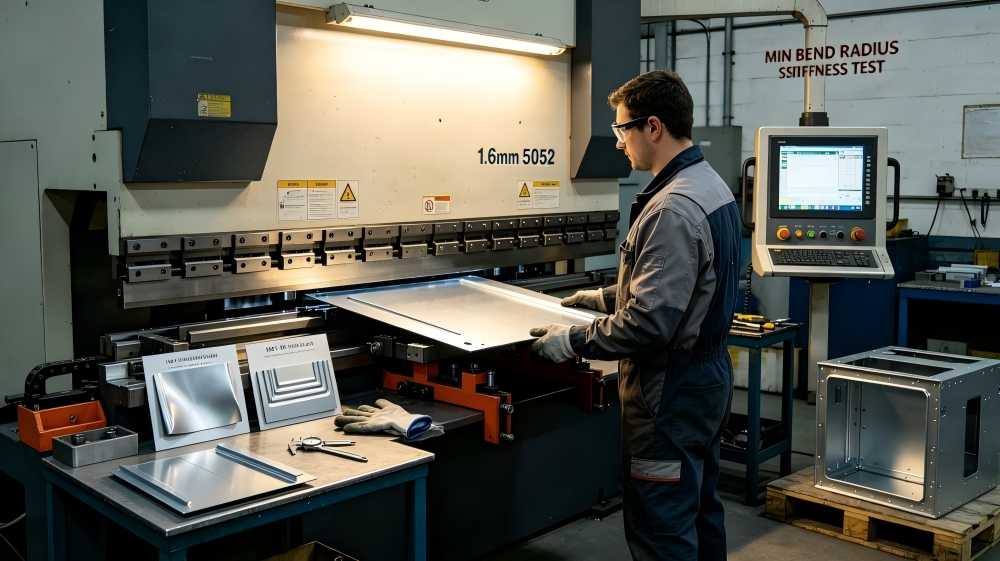
Engineering Factors for Specifying Aluminum Thickness
Determining the ideal aluminum sheet thickness requires balancing mechanical forces against manufacturing constraints.
1. Structural Rigidity and “Oil-Canning”
The stiffness of a flat sheet panel is proportional to the cube of its thickness (t3). Small increases in thickness yield massive gains in deflection resistance.
The 12-Inch Rule: For unsupported spans greater than 12 inches (305mm), a thickness of less than 0.050 inches will likely experience “oil-canning”—an engineering term for the oil-tanker-like popping sound made when a sheet metal face buckles in and out under slight pressure.
Geometrical Optimization: Instead of increasing the overall aluminum sheet thickness to achieve rigidity (which adds cost and weight), engineers should incorporate 90-degree hems, perimeter flanges, or stamped ribs. Formed geometries allow a 0.040″ sheet to exhibit the same localized structural stiffness as a flat 0.063″ sheet.
2. Minimum Bend Radius Compatibility
As aluminum sheet thickness increases, its ductility during bending decreases. Every aluminum alloy and temper has a Minimum Bend Radius (R) expressed as a multiple of thickness (t).
For instance, bending a 0.125″ thick 6061-T6 sheet requires a minimum internal bend radius of roughly 4t to 6t (0.50″−0.75″) to prevent micro-cracking along the tensile outer surface.
If your design requires sharp, crisp bends (e.g., 1t), you must either select a thinner gauge or pivot to a highly ductile alloy like 3003-H14.
The Alloy-Thickness Intersection
Thickness calculations are useless without factoring in the specific aluminum alloy matrix. Yield strength and thickness work in tandem to handle structural stress.
1XXX & 3XXX Series (Low Strength, High Formability)
Alloys such as 1100-H14 and 3003-H14 have excellent corrosion resistance and workability but low mechanical strength.
Thickness Strategy: When substituting steel with 3003 aluminium for general utility apps, you generally need to increase the thickness by 1.5x to match the deflection resistance of the original steel part.
5XXX Series (Medium Strength, Marine Grade)
5052-H32 is the undisputed workhorse of the sheet metal industry. It offers high fatigue strength and excellent weldability.
Thickness Strategy: 5052 has balanced material properties that allow for aggressive down-gauging. This is the ideal alloy choice for working in the 0.050” to 0.090” thickness range for enclosures, chassis and marine brackets.
6XXX & 7XXX Series (High Strength, Structural Grade)
Alloys like 6061-T6 and 7075-T6 are aerospace and structural mainstays.
Thickness Strategy: Due to their great yield strengths, structural skins can be made of very thin sheets (e.g. 0.032″). However, their low elongation factors make them very prone to fracture during cold forming and are best saved for flat profiles, CNC milled sheets or wide radius profiles.
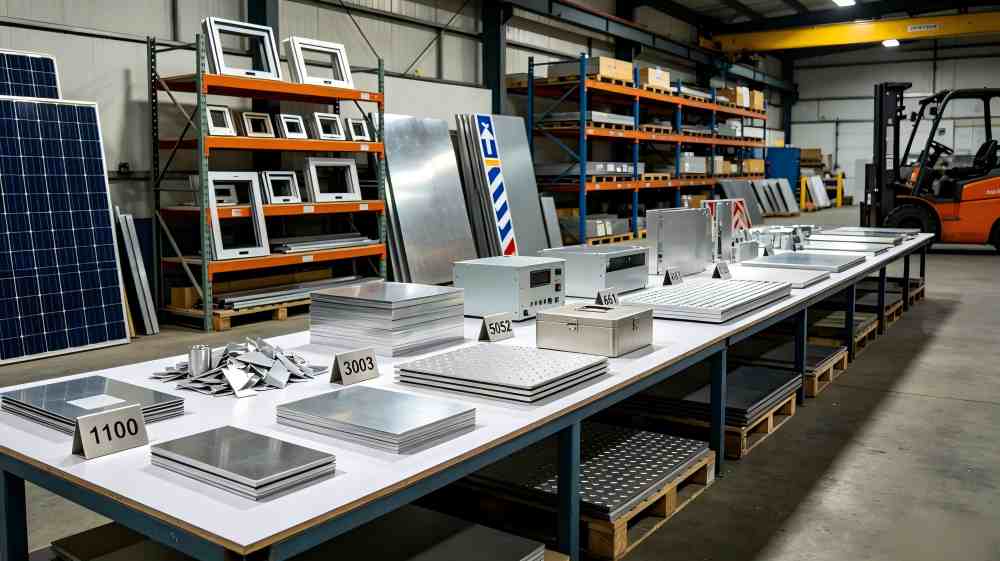
Procurement and Manufacturing Optimization
Designing the perfect theoretical part matters little if the material cannot be sourced efficiently or processed by your production floor.
Stick to Standard Stock Sizes
Ordering non-standard nominal thicknesses (i.e., 0.057”) requires mills or distributors to run special rolling sequences, which results in high Minimum Order Quantities (MOQs) and long lead times. Design your components around the most universally stocked items: 0.032”, 0.040”, 0.063”, 0.090” and 0.125”.
Tooling and Cutting Constraints
The thickness of your chosen aluminum sheet dictates the cutting technology required:
- ≤ 0.063″ (16 Gauge): Can be cleanly processed using mechanical turret punches, traditional stamping presses, and manual shop shears.
- > 0.063″ to 0.125″: Requires heavy mechanical shears, fiber laser cutters, or waterjet cutting systems. Laser cutting aluminum at these thicknesses requires high power settings and assist gases (like Nitrogen) to avoid dross and edge burring.
Frequently Asked Questions
Q1: What is the most popular aluminium sheet thickness for electronic enclosures?
A1: 0.063 inches (1.60mm / 14 gauge) is the standard size for electronics enclosures, rackmount chassis and control panels. It is the best compromise between the thread tapping depth, the stiffness of the structure and the weight.
Q2: How does the temperature affect the choice of aluminium sheet thickness?
A2: Aluminium does not become brittle at low temperatures. In fact, its tensile strength increases in cryogenic environments. But aluminium quickly loses strength at higher temperatures (over 200°F / 93°C). If your application is at elevated temperatures, then you need to increase the aluminium sheet thickness for thermal derating.
Q3: Why do vehicle body panels use 0.040″ thickness instead of 0.032″?
A3: 0.032″ is structurally sound under tension over a frame (like an aeroplane wing), but vehicle body panels are subject to random impacts (rocks, hail). Increasing to 0.040 inches (1.02mm) provides a huge improvement in dent resistance without a prohibitive weight penalty.ature build-up. All the energy savings realize that the relatively large initial investment gives benefits to a life span of the cause.