As an automotive materials chief engineer, I have spent decades watching how thermal management architectures dictate vehicle reliability. I have spent decades watching how thermal management architectures dictate vehicle reliability. In heat exchanger design, material selection is not just a matter of thermal conductivity. It is a calculated trade-off between precision manufacturing, mechanical robustness, and long-term electrochemical stability. In the discussion of the aluminum microchannel tube, two alloys are mainly discussed: 3102 aluminum and 3003 aluminum.
3102 was the unquestioned standard for conventional air conditioning systems for years. The rapid move to electric vehicle (EV) battery packs and high-voltage liquid cooling infrastructure, however, has changed our engineering needs. If you are designing next generation thermal systems, you need to know precisely why 3102 works perfectly in a condenser, why it fails in a battery cold plate, and why 3003 has become the industry standard for liquid-cooled systems.
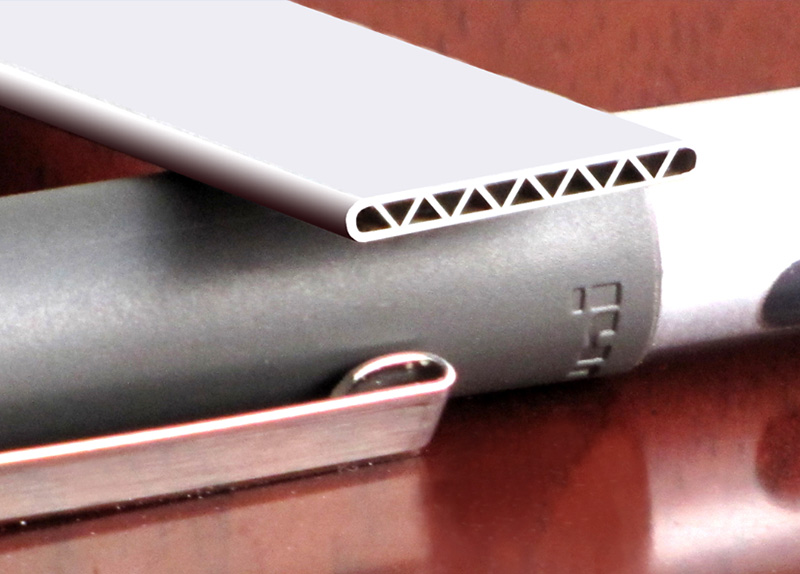
Why 3102 Aluminum Dominates the Condenser Market?
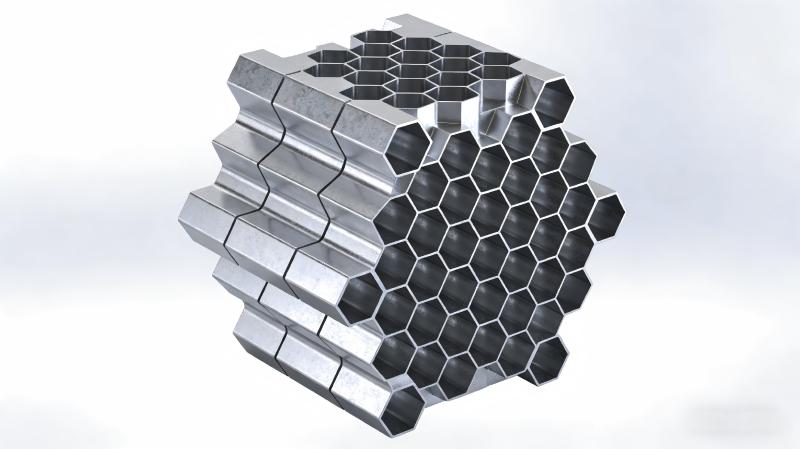
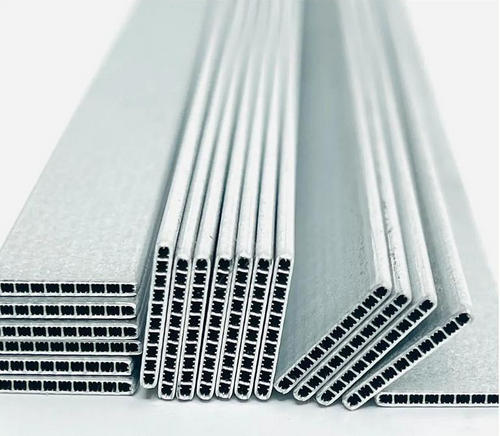
To understand why 3102 aluminum became the default choice for conventional automotive air conditioning (AC) condensers, you have to look at the geometry of an aluminum microchannel tube. A typical AC multiport extrusion (MPE) tube features dozens of microscopic internal channels with web thicknesses often measuring between 0.2mm and 0.3mm.
The Physics of Micro-Extrusion
From a manufacturing standpoint, extrusion pressure is your primary enemy. 3102 is an aluminum-manganese (Al-Mn) alloy, but it keeps its manganese content remarkably low—usually between 0.05% and 0.4%. Because it does not have a high concentration of alloying elements, 3102 behaves very similarly to 1000-series pure aluminum during hot extrusion. It exhibits low deformation resistance.
For our production lines, low deformation resistance means we can extrude these incredibly thin-walled profiles at high speeds without destroying our precision dies. If you use a harder alloy here, die wear skyrockets, and you lose dimensional control over those critical 0.2mm internal walls, leading to immediate quality rejections.
External Corrosion and Controlled Atmosphere Brazing (CAB)
Automotive condensers live at the very front of the vehicle, meaning they are constantly blasted by road salt, moisture, and debris. While 1000-series pure aluminum would easily corrode under these conditions, the controlled addition of manganese in 3102 increases the matrix potential of the metal. This specific chemistry provides solid resistance to localized pitting corrosion.
Furthermore, these microchannel tubes must undergo Controlled Atmosphere Brazing (CAB) to bond with the headers and cooling fins. The brazing process occurs at roughly 600°C, using an aluminum-silicon (Al-Si) filler metal (like 4343 or 4045) which melts at around 577°C. 3102 has a high solidus temperature near 650°C. This wide temperature margin gives us a safe processing window during brazing. It ensures the core tube maintains its structural integrity and resists silicon erosion, where the liquid brazing filler attempts to dissolve and penetrate the thin base metal.
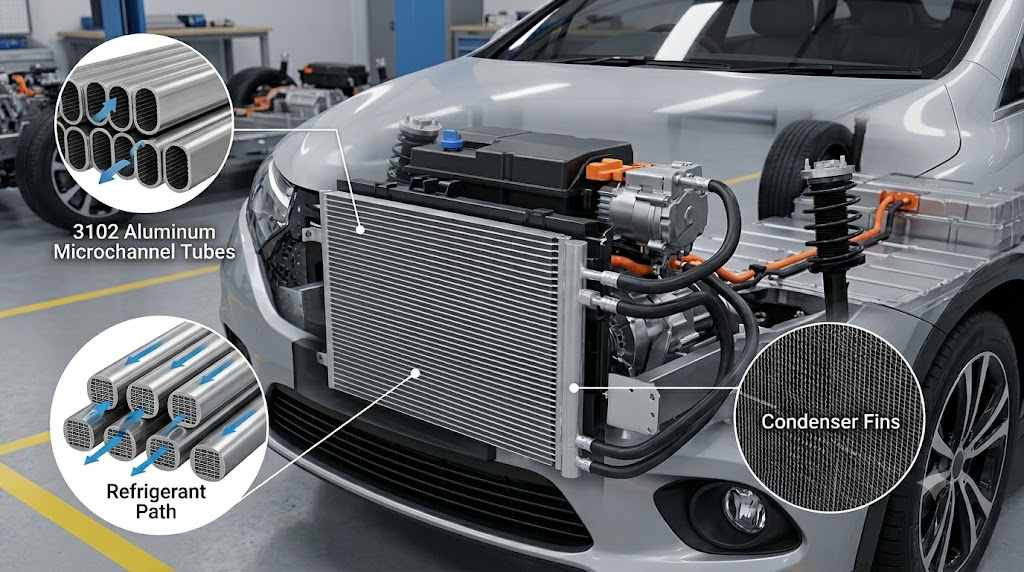
EV Battery Liquid Cold Plates: The Structural and Chemical Failure of 3102
When our engineering teams transitioned from AC loops to electric vehicle battery thermal management, many tried to use the same 3102 aluminum microchannel tube architectures. The results were disastrous, and it comes down to a fundamental change in the working fluid and mechanical environment.
The Chemistry of Water-Glycol Environments
An AC condenser operates with an entirely internal, anhydrous (water-free) environment containing a refrigerant (like R134a or R1234yf) and compressor oil. This setup presents virtually zero risk of internal corrosion.
Conversely, a battery liquid cooling plate circulates a water-glycol antifreeze solution. Water-glycol is naturally aggressive toward aluminum. As the coolant circulates continuously over a 10-to-15-year vehicle lifespan, it causes erosion corrosion. The moving fluid mechanically strips away the protective aluminum oxide layer, exposing raw metal to rapid electrochemical pitting. 3102 simply does not have enough manganese to stabilize its microstructure against this constant internal chemical attack.
Mechanical Stresses in EV Architectures
The second issue is structural. An AC condenser sits suspended at the front of the car, experiencing minimal mechanical loads beyond internal pressure. A battery cold plate, however, is a load-bearing component in terms of contact pressure. It is clamped directly beneath or between heavy battery modules.
During rapid charging and discharging cycles, lithium-ion cells physically expand and contract. This cell swelling exerts massive, repetitive compressive forces directly onto the microchannel tubes. Under these conditions, the low yield strength of 3102 becomes a massive liability. The internal microchannels can collapse or deform under battery pressure, restricting coolant flow, creating hot spots, and risking thermal runaway.
Engineering Performance Matrix: 3102 vs. 3003 Aluminum
To clarify these differences to you, we look at the specific material performance profiles of these two options:
| Engineering Parameter | 3102 Aluminum Properties | 3003 Aluminum Properties |
| Primary Chemical Composition | Al+0.05%∼0.4%Mn | Al+1.0%∼1.5%Mn |
| Mechanical Strength (Yield/Tensile) | Low (Highly ductile, prone to deformation under external load) | High (Significantly harder, resists structural crushing and internal pressure) |
| Internal Media Compatibility | Refrigerants (R134a, R1234yf, CO2) | Water-Glycol Antifreeze Solutions |
| Erosion & Pitting Resistance | Moderate (External focus only) | High (Excellent resistance to internal liquid flow erosion) |
| Extrusion Process Window | Broad (Low die wear, high extrusion speeds) | Narrow (High extrusion resistance, requires robust tooling) |
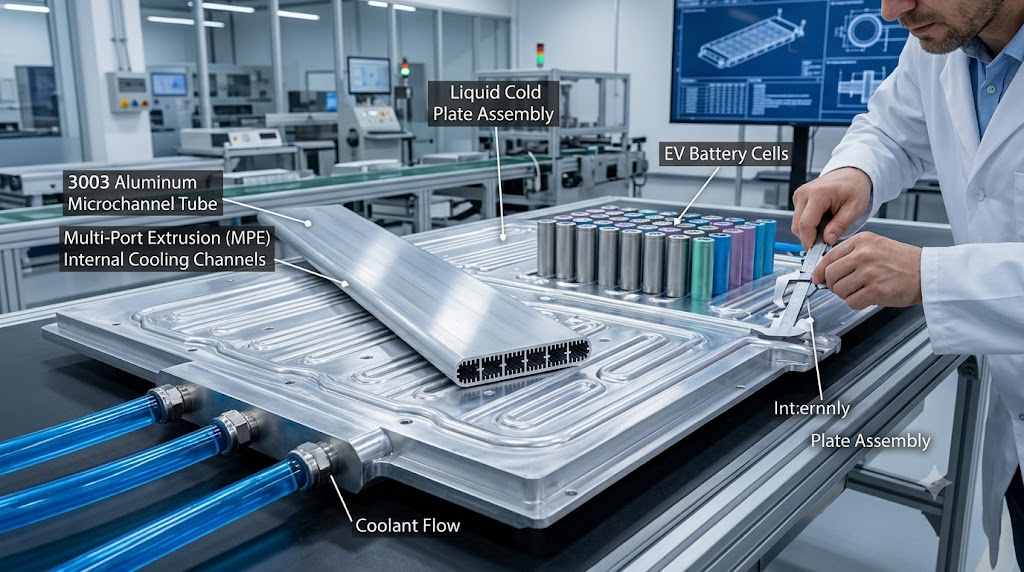
The Solution: Implementing 3003 Aluminum in EV Liquid Cooling Systems
Because of the structural and chemical limitations of 3102, 3003 aluminum (or its engineered variants like 3003 Mod and 3103) has become the standard specification for EV liquid cold plates.
Why 3003 Solves the EV Cold Plate Dilemma?
3003 aluminum contains between 1.0% and 1.5% manganese. This higher concentration changes the performance characteristics of the metal in three critical ways:
- High Mechanical Yield Strength: The addition of manganese creates solid-solution strengthening within the aluminum matrix. When battery modules expand during a 4C fast-charging cycle, a 3003 aluminum microchannel tube retains its shape, protecting the internal fluid channels from collapsing.
- Internal Corrosion Suppression: The refined microstructure of 3003 resists the electrochemical degradation caused by degraded water-glycol mixtures. Advanced formulations (3003 Mod) lower the iron (Fe) impurities and optimize copper (Cu) or titanium (Ti) additions to suppress galvanic cell formation within the alloy itself, preventing internal pinhole leaks.
- Optimized Compatibility with Braze Cladding: In modern cold plate designs, we often use composite long-life alloys. This structure involves a 3003 core for strength and internal corrosion protection, clad with a 4xxx-series alloy on the outside for seamless face-to-face brazing to the structural stamping plates.
Application-Specific Engineering Specs
Depending on your specific cold plate manufacturing process, you should spec your 3003 material according to these three design paths:
- Extruded Multi-Port Flat Tubes: Specify 3003 Mod or 3103. You will need to budget for heavier extrusion presses and slower line speeds compared to 3102, but you get the required internal erosion resistance for water-glycol circulation.
- Stamped / Blown-Up Plates: Specify 3003/4343 composite sheets. This configuration lets you stamp complex fluid topologies directly into the sheet metal while using the integrated cladding layer to seal the entire assembly in a CAB furnace without auxiliary fluxing.
- Snake Tubes for Cylindrical Cells: Specify 3003-O temper (fully annealed). When wrapping cooling channels tightly around 21700 or 4680 cylindrical cells, you need maximum elongation. The O-temper provides the necessary ductility to bend the tube at tight radii without micro-cracking along the outer tension wall.
When you’re designing automotive heat exchangers, you can’t take a one-size-fits-all approach to sourcing your aluminium microchannel tube. If you are looking at traditional AC loops where manufacturing cost and extreme thin-wall extrusion are your driving metrics, 3102 aluminium is still the most efficient choice due to its low deformation resistance and adequate external corrosion profile.
But if you’re working on a project related to an EV battery pack, an electric drive unit (EDU) cooler or a chiller assembly, you have to design for a high-stress, water-glycol environment. For those applications, the use of 3003 aluminium is required to ensure the structural integrity and corrosion life of your thermal management system.