When selecting an aluminum brazing alloy for a composite aluminum tube, 4045 and 4343 are two of the most commonly considered options. Both are Al-Si alloys designed to melt and flow at temperatures below the aluminum core material, allowing brazed joints to form without melting the structural tube.
Neither 4045 nor 4343 is universally better. In general, 4045 is preferred when higher filler-metal flow, larger fillets, or a lower brazing temperature are important, while 4343 can be advantageous when more controlled filler flow and lower interaction with the core material are priorities. The final choice should also consider the core alloy, tube wall thickness, cladding ratio, joint geometry, brazing process, and service requirements.
For composite aluminum tubes used in heat exchangers, radiators, condensers, evaporators, oil coolers, and similar assemblies, understanding this difference helps engineers specify the right material combination instead of selecting a brazing alloy based only on its nominal composition.
Why Is Brazing Alloy Important in a Composite Aluminum Tube?
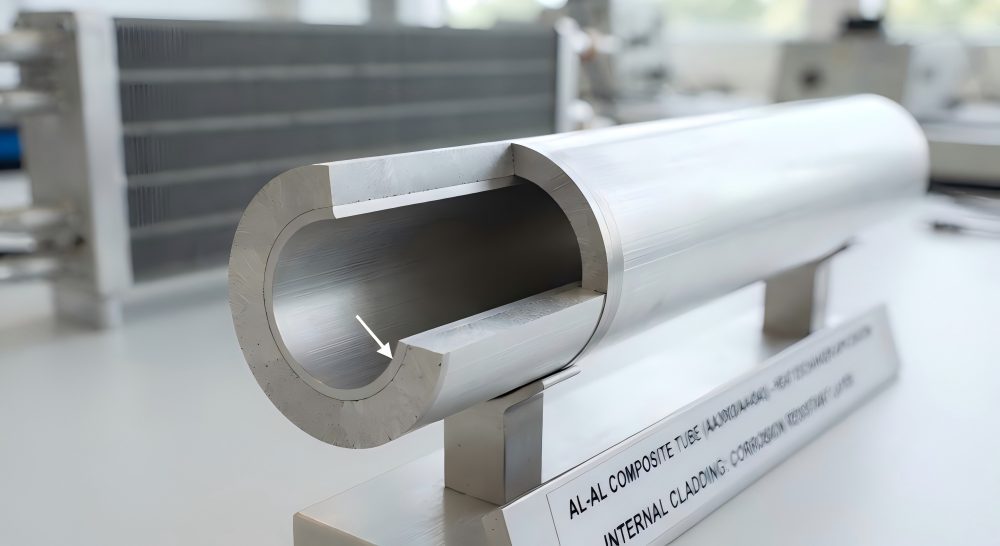
A composite aluminum tube normally combines a structural core alloy with an aluminum-silicon cladding layer. The core provides most of the tube’s structural and service properties, while the lower-melting Al-Si layer acts as the brazing material during assembly.
During brazing, the cladding layer melts and flows into the joint area. After cooling, it forms a metallurgical bond between the tube and the mating component. This means the brazing layer must satisfy several requirements:
- Melt before the core alloy loses its structural integrity.
- Flow sufficiently to fill the designed joint.
- Provide reliable wetting and joint formation.
- Avoid excessive dissolution or erosion of the core.
- Maintain adequate corrosion and pressure performance after brazing.
- Remain compatible with the selected brazing process.
Al-Si alloys are widely used because silicon reduces the melting temperature of aluminum and increases filler-metal fluidity. Commercial aluminum brazing fillers commonly include 4343 and 4045, with 4047 representing a higher-silicon alternative.
For an Al-Al composite tube manufacturer, therefore, choosing 4045 or 4343 is not simply a matter of choosing one alloy over another. It is a matter of balancing melting behavior, filler flow, core interaction, tube design, and production conditions.
4045 vs. 4343 Aluminum Brazing Alloy: Key Differences
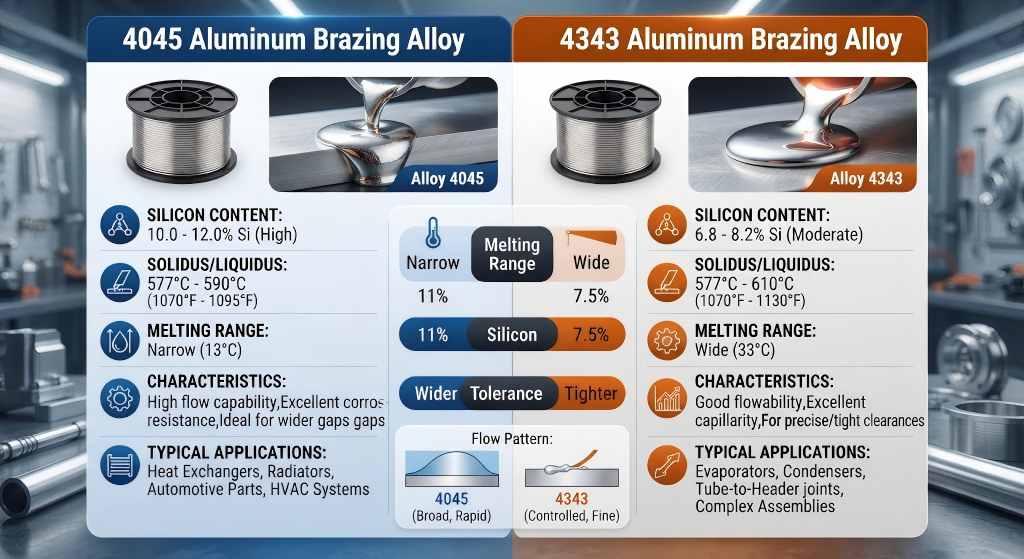
The most important difference between 4045 and 4343 is their silicon content. Typical 4045 contains approximately 10% Si, while 4343 contains approximately 7.5% Si. This difference changes the melting range and brazing behavior of the two alloys.
| Property | AA 4045 | AA 4343 |
| Alloy family | Al-Si | Al-Si |
| Nominal Si content | ~10% | ~7.5% |
| Typical solidus | ~577°C | ~577°C |
| Typical liquidus | ~591°C | ~613°C |
| Typical recommended brazing range | ~588–604°C | ~593–621°C |
| Relative filler flow | Higher | More controlled |
| Melting range | Narrower | Wider |
| Typical application role | Brazing/cladding | Brazing/cladding |
| Main selection advantage | Lower-temperature operation and stronger flow | Controlled flow and lower core interaction |
Published technical data show that both alloys begin melting at approximately 577°C, but 4045 reaches a fully molten condition at a lower temperature than 4343. Consequently, the commonly reported recommended brazing range for 4045 is also lower.
These numbers should be treated as typical reference values rather than universal production specifications. Actual brazing conditions depend on alloy chemistry, tube geometry, cladding thickness, furnace profile, joint clearance, flux or atmosphere, and the manufacturer’s validated process.
How Silicon Content Changes Brazing Performance?
Silicon is the key compositional factor behind much of the difference between 4045 and 4343. As silicon content increases within the relevant Al-Si system, the melting characteristics change and filler-metal fluidity generally increases. The Al-Si system reaches a eutectic composition at approximately 11.7% Si, which helps explain why higher-Si alloys have a narrower melting range and greater fluidity.
4045: Higher Silicon and Greater Fluidity
With approximately 10% Si, 4045 has more silicon than 4343. Its narrower melting range allows it to become fully molten at a lower temperature. This can provide:
- Earlier filler-metal flow.
- Better filling of certain joint geometries.
- Greater ability to form larger fillets.
- A lower typical brazing-temperature range.
- Greater flexibility when the process requires strong filler flow.
Technical references specifically identify 4045 as a preferred option when larger fillets are required or when brazing is likely to occur at lower temperatures.
4343: Lower Silicon and More Controlled Flow
4343 contains approximately 7.5% Si. Its wider melting range means the transition from solid to fully liquid occurs over a larger temperature interval. Compared with 4045, 4343 generally provides less aggressive filler flow and is less aggressive in dissolving the core alloy. This characteristic can be valuable when the design requires more controlled filler-metal behavior.
Therefore, the higher Si content of 4045 should not automatically be interpreted as “better.” It simply shifts the balance toward lower-temperature melting and greater fluidity.
4045 vs. 4343 for Brazing Temperature Control
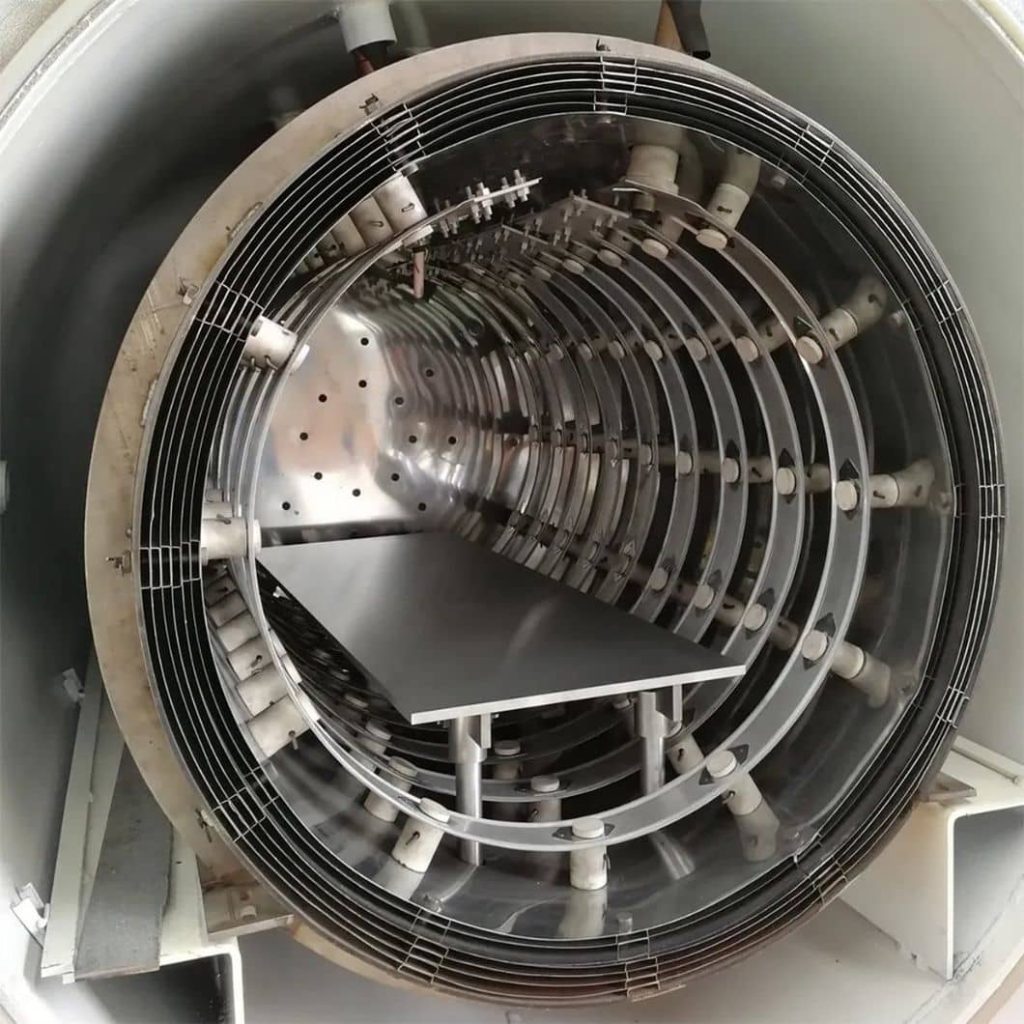
Brazing temperature is one of the most important factors when selecting the cladding alloy. For typical aluminum heat-exchanger brazing applications, published data place the recommended brazing range around 588–604°C for 4045 and 593–621°C for 4343.
This difference can be important when processing thin-wall tubes or assemblies containing multiple aluminum components with different thermal characteristics.
Why 4045 Can Be Advantageous?
4045 reaches a fully molten state at a lower temperature. It can therefore be useful when the process is designed around:
- A lower brazing temperature.
- Faster filler-metal activation.
- Strong filler flow.
- Larger fillet formation.
- Heat-sensitive component configurations.
Why 4343 Can Be Advantageous?
4343 requires a somewhat higher temperature to become fully molten, but its wider melting interval can provide more controlled filler behavior. This may be useful when:
- Excessive filler flow must be avoided.
- Core-metal dissolution needs to be controlled.
- Joint geometry does not require highly aggressive filler flow.
- The existing production process has already been optimized for 4343.
However, alloy selection should never be based on brazing temperature alone. Furnace atmosphere, heating rate, holding time, joint clearance, cladding thickness, surface condition, and flux selection can all affect brazing quality.
Which Alloy Has Better Filler-Metal Flow?
4045 generally provides greater filler-metal fluidity than 4343. This is one of the most practical distinctions between the two alloys.
Higher fluidity can be beneficial when molten filler metal needs to travel through a joint and create a sufficiently sized fillet. Technical references describe 4343 as the less-fluid of the common 4xxx-series filler alloys, while 4045 occupies an intermediate position between 4343 and the higher-silicon 4047 alloy.
However, higher filler flow does not automatically mean better brazing performance. Excessive flow can create other problems, including filler accumulation, unwanted spreading, and increased interaction with the core alloy.
The ideal filler behavior depends on the joint design. For example, a complicated joint requiring good filler distribution may benefit from 4045, while a thin-wall composite tube where controlled filler movement is more important may favor 4343.
How 4045 and 4343 Affect Core-Metal Erosion?
Core-metal interaction is an important consideration that is sometimes overlooked when selecting a brazing alloy. During brazing, liquid filler metal can interact with the solid core alloy. Two related phenomena are commonly discussed:
Dissolution occurs when the liquid filler interacts with and dissolves part of the core material without necessarily changing the overall joint geometry.
Erosion is more dynamic. Flowing liquid filler can remove core material and reduce the local wall thickness or alter the joint geometry. Research on aluminum heat exchangers indicates that excessive dissolution and erosion can affect joint geometry, pressure/temperature resistance, and corrosion performance.
Because 4045 has higher Si content and greater fluidity than 4343, its process conditions need to be carefully controlled when core-metal interaction is a critical concern. Important variables include:
- Brazing peak temperature.
- Time above the liquidus temperature.
- Heating rate.
- Joint clearance.
- Filler-metal volume.
- Cladding thickness.
- Tube wall thickness.
- Core alloy composition.
- Filler flow path.
Therefore, it would be incorrect to say that choosing 4343 alone eliminates erosion risk. Brazing-process control is just as important as alloy selection.
When Should You Choose 4045 for a Composite Aluminum Tube?
4045 can be a strong choice when the application prioritizes filler flow and lower-temperature brazing. It may be appropriate when:
1. A lower brazing temperature is desirable
The typical liquidus and recommended brazing range of 4045 are lower than those of 4343.
2. The joint requires greater filler flow
4045 can provide stronger filler movement than 4343, which may help with certain joint geometries.
3. Larger fillets are required
Industry guidance specifically identifies 4045 as a preferred choice when larger fillets are desirable.
4. The production process has been validated for 4045
If the tube geometry, cladding ratio, furnace profile, and joining components have already been qualified with 4045, changing to 4343 should not be treated as a simple material substitution.
A new alloy can change filler flow, thermal requirements, joint formation, and post-braze performance.
When Should You Choose 4343 for a Composite Aluminum Tube?
4343 can be preferred when the priority is controlled filler behavior and reduced interaction with the core alloy.
It may be suitable when:
- Filler flow must remain relatively controlled.
- The joint geometry does not require highly aggressive filler movement.
- Core-metal dissolution is a major design consideration.
- The existing brazing process has been qualified for 4343.
- The tube uses a thin wall or a geometry sensitive to local material loss.
- The application requires predictable brazing behavior across a high-volume production process.
4343 is widely used as a brazing-cladding alloy, particularly in controlled-atmosphere brazing applications. The key point is that 4343 should not be regarded as a “weaker” alternative to 4045. The two alloys provide different balances between melting range, flow behavior, and core interaction.
4045 vs. 4343: Which One Is Better?
The most useful way to answer this question is to match the alloy to the engineering requirement.
| Requirement | Preferred Direction |
| Lower typical brazing temperature | 4045 |
| Greater filler-metal flow | 4045 |
| Larger fillet formation | 4045 |
| More controlled filler flow | 4343 |
| Lower tendency for aggressive core interaction | 4343 |
| Existing process validated for 4045 | 4045 |
| Existing process validated for 4343 | 4343 |
| Complex joint requiring strong filler flow | 4045 may be suitable |
| Thin-wall design sensitive to core erosion | 4343 may be suitable |
The practical conclusion is: Choose 4045 when lower-temperature brazing and stronger filler flow are important. Choose 4343 when more controlled filler behavior and lower core-metal interaction are higher priorities. Neither alloy should be selected independently of the tube design.
What Other Factors Should Buyers Consider?
For a composite aluminum tube, the brazing alloy is only one part of the material specification.
1. Core Alloy
The core alloy determines much of the tube’s structural, thermal, corrosion, and forming performance. CHAL’s composite tube configurations can use different aluminum alloys according to the application and required properties. The core and cladding alloys must therefore be considered as a material system, not as two independent materials.
2. Cladding Ratio
Cladding thickness affects the amount of filler available during brazing. CHAL’s composite aluminum tube product range can be configured with composite ratios according to product requirements. For reference, the product information specifies composite rates in the approximately 5–12% range.
The appropriate ratio depends on:
- Tube dimensions.
- Joint design.
- Brazing method.
- Required filler volume.
- Wall thickness.
- Manufacturing tolerances.
Published clad-product data also show that cladding percentages vary according to component thickness and application requirements rather than following one universal value.
3. Tube Diameter and Wall Thickness
A 4045 or 4343 cladding specification cannot be evaluated without knowing the tube geometry. Tube OD and wall thickness influence:
- Heat transfer.
- Internal pressure.
- Formability.
- Brazing heat input.
- Core-metal erosion sensitivity.
- Dimensional stability.
- Required cladding thickness.
For engineers comparing different tube designs, heat exchanger tube selection should therefore consider more than thermal performance alone. Tube geometry, alloy combination, brazing compatibility, operating pressure, and manufacturing requirements should be evaluated as an integrated system.
4. Joint Geometry
The joint gap and geometry strongly affect capillary flow. A filler alloy with high fluidity may be beneficial in a difficult-to-fill joint, but excessive filler flow may be undesirable where the geometry already promotes rapid spreading.
Therefore, the correct question is not: “Which alloy flows better?” It is: “Which filler-flow behavior matches the joint geometry and brazing process?”
5. Brazing Method
The selected composite tube must also be compatible with the intended brazing process. Controlled-atmosphere brazing and other aluminum brazing methods require careful control of peak temperature, heating rate, holding time, joint clearance, and filler-metal distribution.
For heat exchanger applications, brazing compatibility for heat exchanger tubes should be evaluated together with tube geometry, alloy selection, and cladding thickness. These factors determine whether the filler metal can melt and flow properly while maintaining the required joint integrity and avoiding excessive interaction with the tube core.
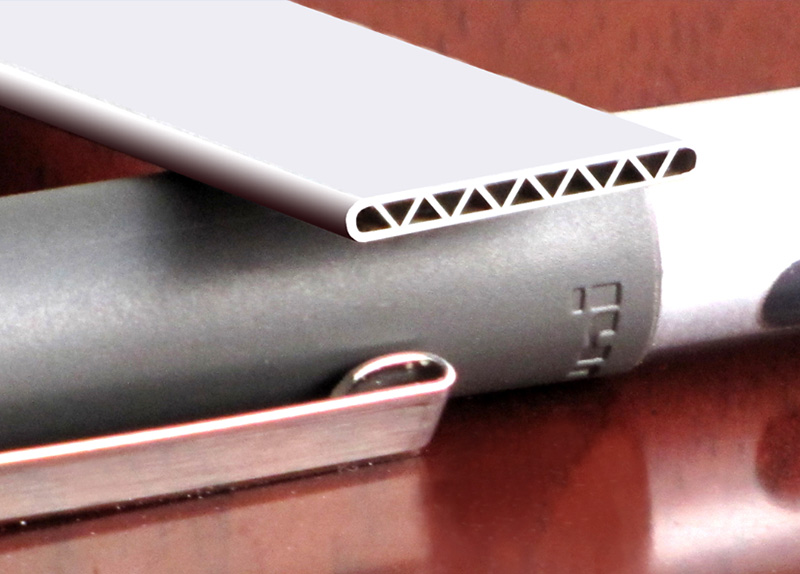
For a broader discussion of tube geometry, alloy selection, wall thickness, and brazing considerations, engineers can also refer to guidance on selecting aluminum micro-channel tubes for heat exchangers.
Can 4045 and 4343 Be Used Interchangeably?
Not automatically. Although both are Al-Si brazing alloys and can serve similar functions, they do not have identical melting ranges or filler-flow behavior.
Changing from 4343 to 4045 can affect:
- Brazing temperature.
- Furnace profile.
- Filler-metal flow.
- Fillet formation.
- Core-metal interaction.
- Joint geometry.
- Post-braze properties.
Consequently, an alloy substitution should be validated through brazing trials and appropriate inspection rather than treated as a direct drop-in replacement. For production applications, the manufacturer should evaluate the complete tube-and-joint system before changing the cladding alloy.
FAQ
Q1: Is 4045 or 4343 better for composite aluminum tubes?
Neither is universally better. 4045 is generally more suitable when lower-temperature brazing and greater filler flow are required, while 4343 may be preferable when controlled filler flow and lower core interaction are priorities.
Q2: What is the main difference between 4045 and 4343 aluminum brazing alloys?
The primary difference is silicon content. Typical 4045 contains about 10% Si, while 4343 contains about 7.5% Si. This difference affects melting range, filler-metal fluidity, and brazing temperature.
Q3: Does 4045 melt at a lower temperature than 4343?
Both typically begin melting at approximately 577°C, but 4045 reaches a fully molten condition at a lower temperature. Typical published liquidus values are about 591°C for 4045 and 613°C for 4343.
Q4: Why is 4045 more fluid than 4343?
Its higher silicon content produces different melting behavior and a narrower melting range, allowing the filler metal to become liquid over a smaller temperature interval. This generally results in greater filler-metal fluidity.
Q5: Can 4045 and 4343 be used interchangeably?
Not without validation. The two alloys have different melting and flow characteristics, so changing the cladding alloy may require adjustments to the brazing process and joint design.