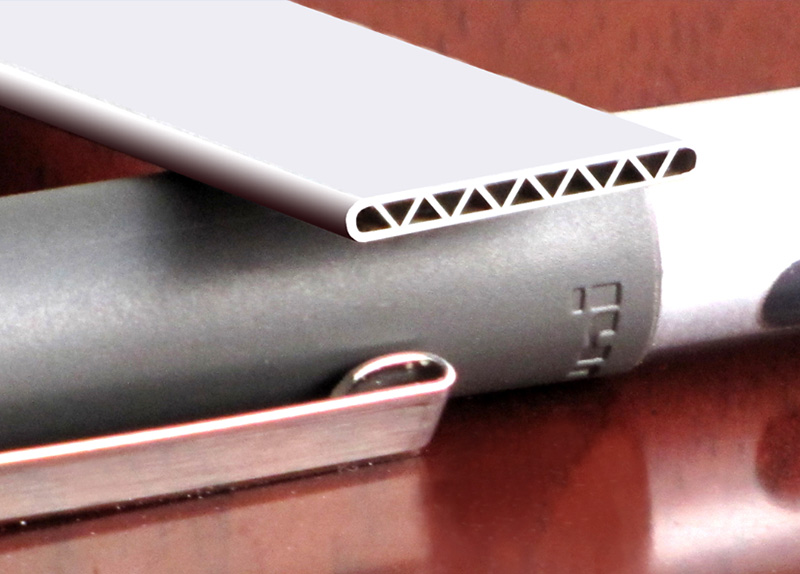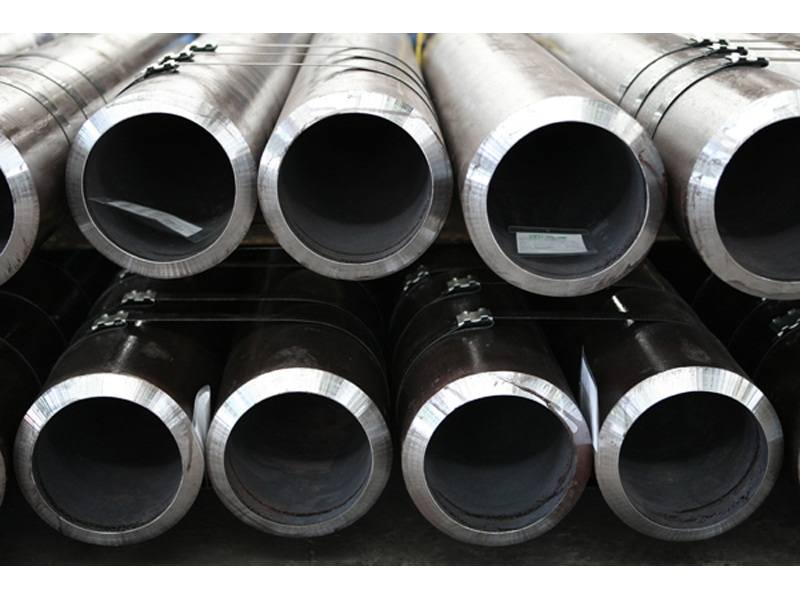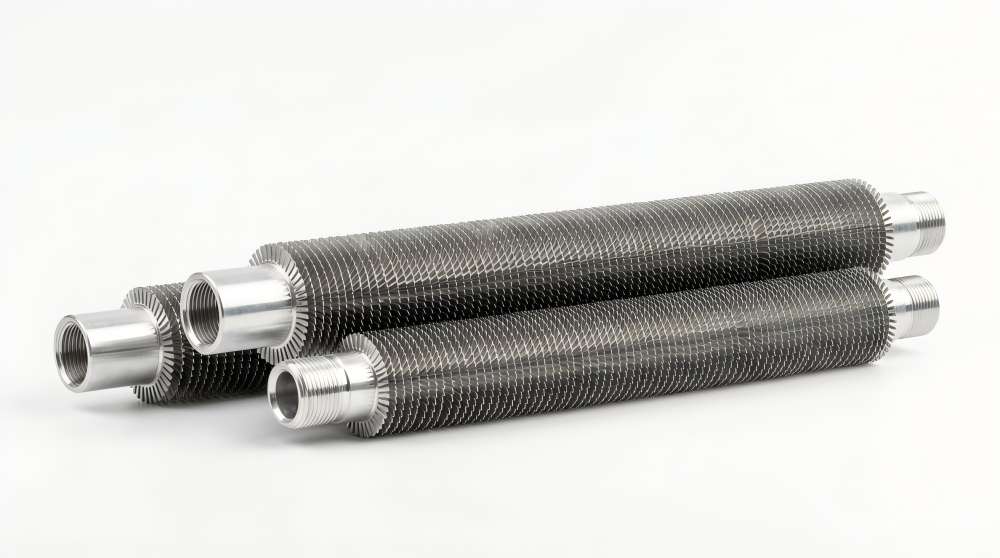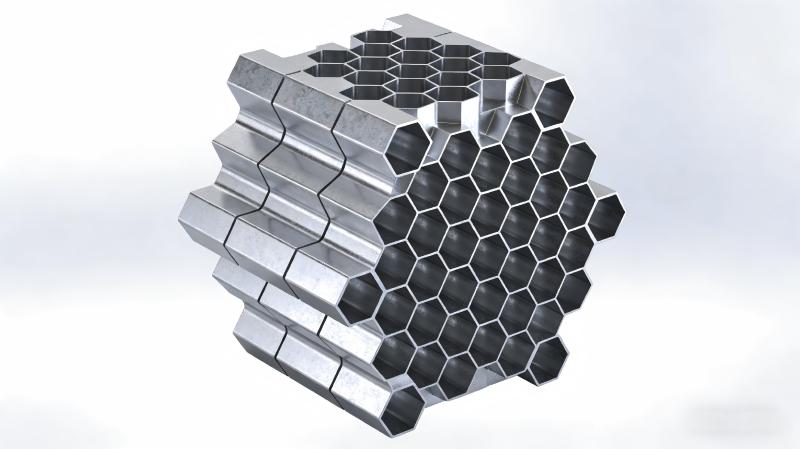
For aluminum condenser and heat exchanger applications, round and D-type aluminum condenser header pipes are two common options. Round headers offer a conventional circular geometry with predictable mechanical behavior and broad application experience, while D-type headers can provide greater flexibility when installation space or component geometry is constrained.
There is no universal answer to whether a round or D-type header is better. The appropriate choice depends on the heat exchanger architecture, required flow area, available installation space, operating pressure, port configuration, brazing process and production requirements.
This guide compares the two profiles from an engineering and manufacturing perspective and explains how to select the right aluminum condenser header pipe for HVAC, automotive and new energy applications.
What Is an Aluminum Condenser Header Pipe?
An aluminum condenser header pipe, also called an aluminum condenser manifold or collector tube, is used to distribute or collect refrigerant among multiple circuits in a heat exchanger. In a typical condenser or evaporator, several smaller tubes or flow channels work in parallel. The header provides a larger common flow passage so that refrigerant can enter, leave or redistribute between these circuits with relatively small influence from the header itself. A properly designed header therefore helps maintain more consistent flow distribution and reduces the risk of temperature non-uniformity across the heat exchanger.
Aluminum is widely used for these components because it combines low density, good formability, corrosion resistance, weldability and suitability for brazed heat exchanger assemblies. CHAL’s condenser header pipe products use core alloys such as 3003, 3305 and 6063, with optional cladding materials including 4045, 4343, 4043 and 7072 depending on the application and required surface or brazing characteristics.
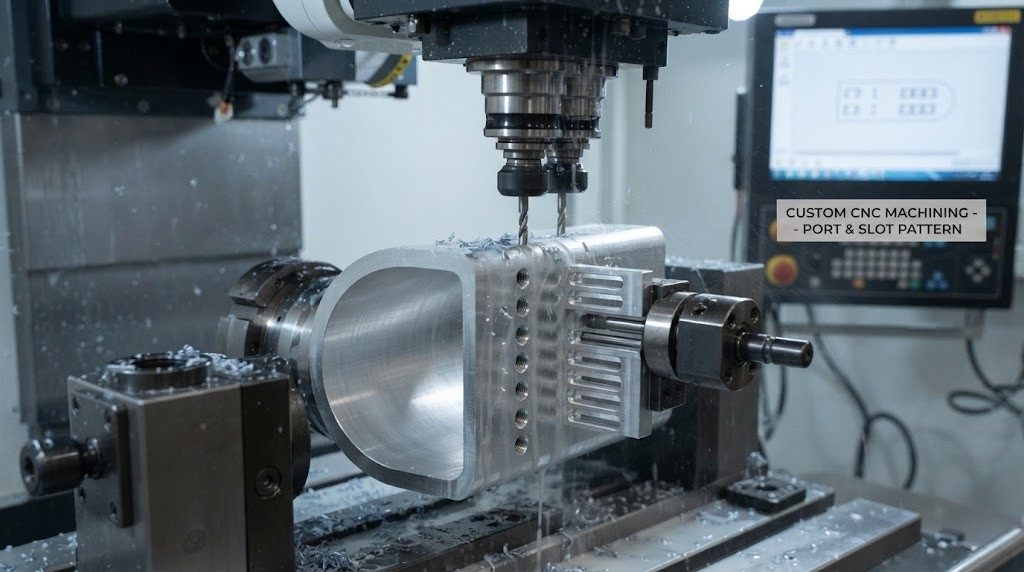
The header can also be supplied as a relatively simple tube or processed into a finished collector with punched ports, slots, baffles and welded connection blocks, depending on the customer’s heat exchanger design.
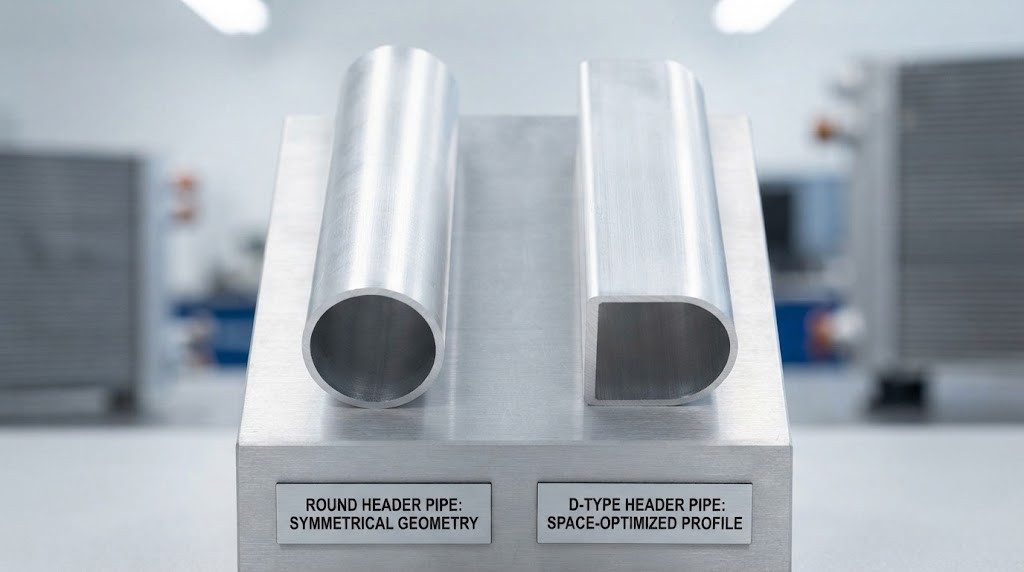
Round vs. D-Type Header Pipe Profile Comparison
Round vs. D-Type Aluminum Header Pipe: What Is the Difference?
The fundamental difference is the cross-sectional geometry.
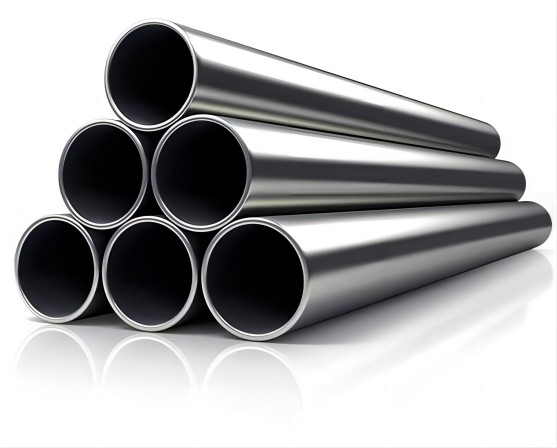
A round aluminum header pipe has a circular cross-section. The wall is distributed around the circumference, creating a symmetrical geometry that has been widely used in conventional condensers, evaporators, HVAC equipment and other heat transfer systems.
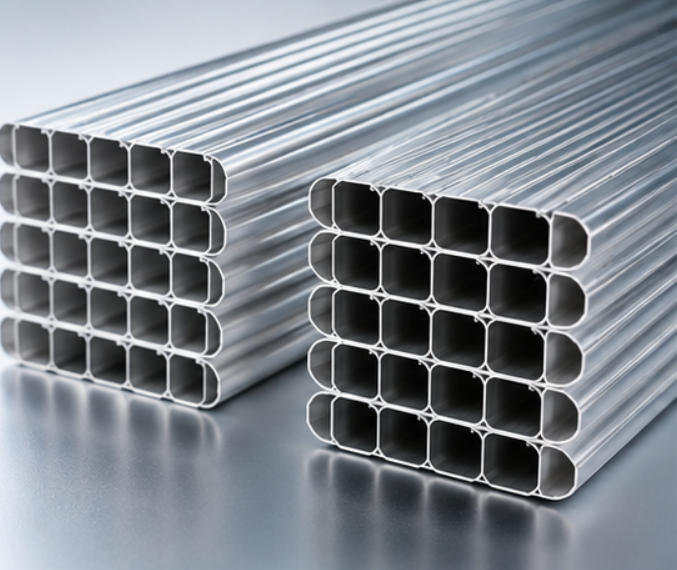
A D-type aluminum header pipe uses a modified profile with a flat or substantially flatter side combined with a curved section. This changes the external envelope and allows the header to fit particular heat exchanger configurations more efficiently.
CHAL currently supplies round header sizes such as P20×1.15, P28×1.6, P30×1.5 and P38×2, while its D-type range includes profiles such as PD20×18, PD20.4×18.5, PD25.5×19 and other customized dimensions. The listed products cover different wall thicknesses and dimensional tolerances for specific collector designs. The key point is that profile shape should be selected according to the complete heat exchanger design rather than treated as an isolated tube specification.
| Design Factor | Round Header Pipe | D-Type Header Pipe |
| Cross-section | Circular | D-shaped / modified profile |
| Space utilization | Good | Often better in constrained layouts |
| Mechanical geometry | Symmetrical | Direction-dependent |
| Conventional HVAC use | Excellent | Good |
| Compact assemblies | Good | Excellent |
| Port customization | High | High |
| Manufacturing maturity | Very high | High |
| Custom geometry | Good | Excellent |
| Best selection basis | Standardized designs | Space-optimized designs |
Advantages and Limitations of Round Aluminum Condenser Header Pipes
1. Uniform Circular Geometry
The most obvious advantage of a round header is its symmetrical cross-section. The geometry is consistent in every radial direction, making it straightforward to incorporate into conventional pressure-containing and flow-distribution designs.
For many HVAC and automotive heat exchangers, the round profile is already well established. Engineers can select the diameter and wall thickness based on system requirements without introducing an additional profile constraint.
2. Flexible Diameter and Wall Thickness Selection
Round header pipes can be produced in a broad range of diameters and wall thicknesses. CHAL’s current product range, for example, includes round headers from relatively small diameters such as 12 mm and 15.88 mm to larger profiles around 38–39.4 mm, with wall thicknesses covering approximately 1–2.7 mm in the listed specifications. This variety makes the round profile suitable for different heat exchanger capacities and physical dimensions.
3. Established Manufacturing Process
Round welded tubes are relatively straightforward to integrate with processes such as cutting, punching, drilling and subsequent brazing preparation. CHAL manufactures condenser header tubes using high-frequency welding and can further process the tube according to customer drawings. For projects where production simplicity, repeatability and established tooling are important, a round header can therefore be an efficient choice.
4. Limitations of Round Profiles
The main limitation is packaging. A circular tube occupies a cylindrical envelope, which may leave unused space when the header has to be positioned against a flat heat exchanger frame, side plate or other component. In a highly compact assembly, even a small reduction in external dimensions can affect the overall heat exchanger package. In these cases, a D-type profile may offer greater design flexibility.
Advantages and Limitations of D-Type Aluminum Condenser Header Pipes
1. Better Packaging Efficiency
The major reason engineers consider a D-type header is usually space utilization. The modified cross-section can be designed to fit more closely against adjacent components or within a restricted installation envelope. This can be useful when the heat exchanger has strict width, height or depth limitations.
For automotive and new energy thermal systems, where packaging space is often highly constrained, this characteristic can be particularly valuable.
2. Greater Geometric Flexibility
A D-type header can be integrated into heat exchanger structures where a circular tube is not the most efficient external shape. CHAL’s D-type products include different width-to-height combinations, such as PD20×18, PD20.4×18.5, PD25.5×19 and PD38×27. This demonstrates that D-type headers can be tailored to different collector geometries rather than being limited to one standardized cross-section.
3. Suitable for Customized Collectors
D-type and round tubes can both be supplied with additional processing. Depending on the design, this may include slots, drilled holes, baffles and welded connection blocks. CHAL specifically notes that welded tubes can be supplied as ready-to-use collector components and can be stamped according to customer drawings. This is important because the final performance of a header depends not only on its outer profile but also on the location and size of its ports and internal flow arrangement.
4. Limitations of D-Type Profiles
A D-type profile is not automatically stronger, more efficient or less expensive than a round tube. Its performance depends on the complete geometry, including width, height, wall thickness, internal flow area, port arrangement and operating conditions. Because the cross-section is directional, dimensional control is particularly important when the header must interface precisely with other components.
Therefore, D-type should be selected because it solves a specific packaging or design requirement—not simply because its shape appears more compact.
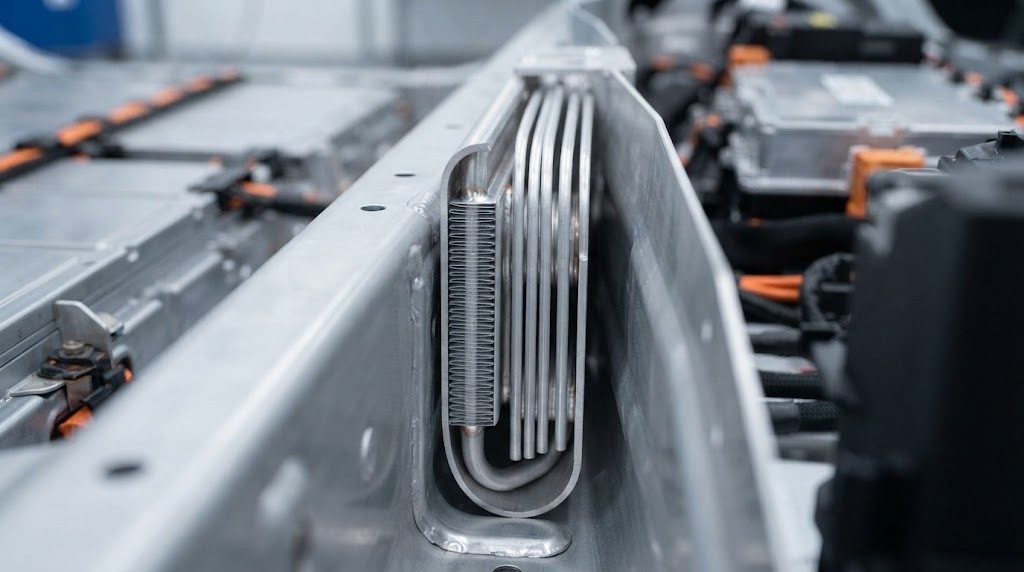
Round vs. D-Type: Which Performs Better?
The answer depends on which performance characteristic is being evaluated.
Flow Distribution
Neither profile should automatically be considered superior for refrigerant distribution. Header diameter, internal volume, inlet position, outlet/port arrangement, circuit layout and operating conditions generally have a greater influence on distribution than the external shape alone.
A header should be large enough and configured appropriately so that pressure and velocity changes inside the collector do not excessively influence individual circuits. For this reason, engineers should evaluate the complete header and circuit configuration rather than selecting a profile based only on round versus D-type geometry.
Pressure and Mechanical Behavior
A circular tube has a symmetrical wall arrangement, which gives it a predictable structural response under internal pressure. A D-type profile can also be designed for pressure applications, but its performance must be evaluated according to the actual cross-section, wall thickness, material condition and design pressure.
Consequently, wall thickness should not be selected solely from the external dimensions. For a production design, the pressure requirement, material specification and applicable engineering standards should be considered together.
Space Efficiency
This is where D-type headers often have an advantage. If the available installation envelope is rectangular or otherwise constrained, a D-type profile can potentially use the available space more effectively than a circular tube of comparable flow capacity. For conventional systems with sufficient clearance, however, the packaging advantage may not justify changing from an established round design.
Manufacturing
Round tubes generally benefit from highly established manufacturing and processing methods. D-type tubes are also available as precision welded products, but the forming, sizing and dimensional-control requirements depend more strongly on the specific profile. For high-volume production, both can be viable. The decisive factor is usually whether the profile matches the customer’s existing tooling, brazing process and assembly configuration.
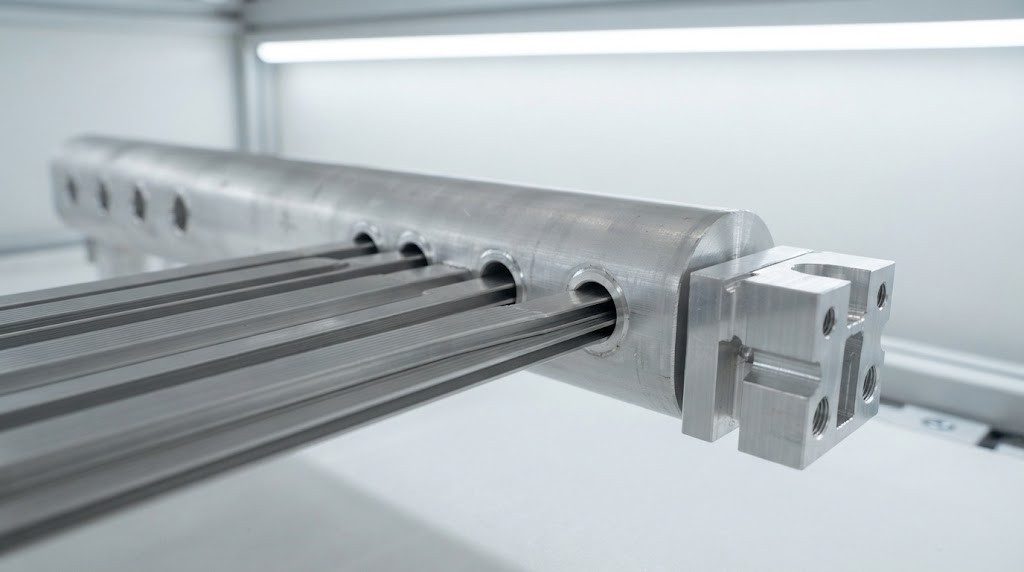
Round vs. D-Type for Brazing
Brazing quality should be evaluated separately from tube shape. Aluminum condenser headers frequently use clad materials to support brazing and corrosion-control requirements. CHAL offers single-side or double-side cladding, with cladding materials including 4045, 4343, 4043 and 7072, and can provide different cladding ratios according to customer requirements.
For either round or D-type headers, important brazing considerations include:
- Alloy and cladding combination
- Cladding thickness
- Wall thickness
- Port geometry
- Joint clearance
- Dimensional accuracy
- Surface condition
- Brazing temperature and cycle
- Position of adjacent components
Therefore, a D-type header is not inherently easier or harder to braze than a round header. The quality of the joint depends on the complete material and joint design. For OEM applications, the header profile and brazing configuration should ideally be developed together rather than selected independently.
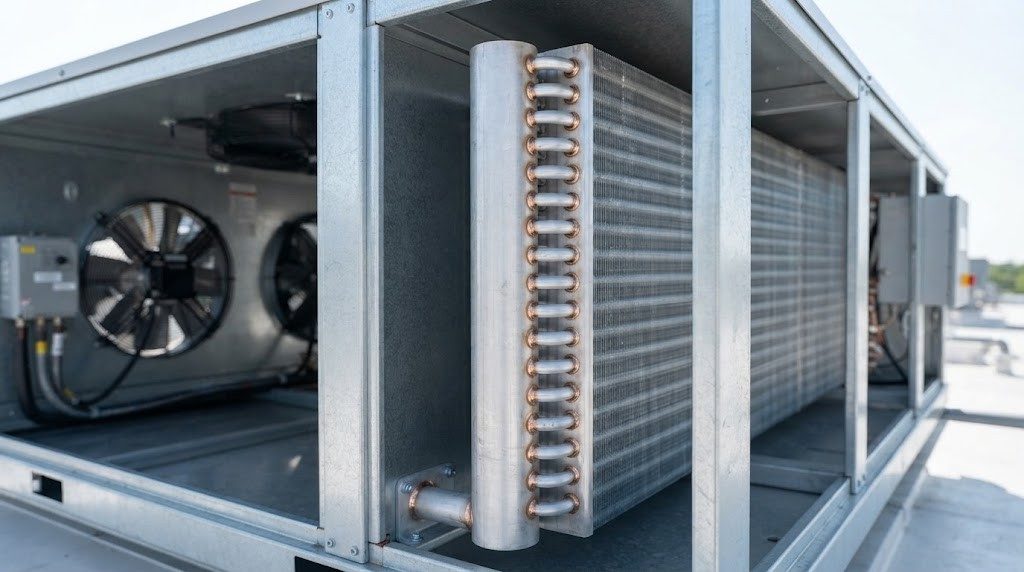
Round vs. D-Type for Automotive and EV Thermal Management
Automotive thermal management is creating demand for increasingly compact and integrated heat exchanger assemblies. Round headers remain highly suitable for conventional automotive air-conditioning condensers and other heat exchangers where the packaging geometry is compatible with a circular collector. D-type headers become particularly interesting when the available space is restricted or when the collector needs to integrate closely with other components.
CHAL’s round/D-type welded tube range is already positioned for condenser collectors and includes customized processing such as slots and other collector features. The company also identifies automotive and new energy vehicle applications for its condenser header products.
For EV thermal management, the selection may involve more than the traditional condenser alone. Battery cooling, refrigerant circuits, chillers and integrated thermal modules can all impose different packaging requirements. In these applications, profile optimization can become an important part of the overall thermal-management design.
How to Choose Between Round and D-Type Aluminum Header Pipes?
A practical selection process should start with the heat exchanger rather than the tube.
Step 1: Define the Available Installation Space
Measure the maximum width, height and depth available for the header. If there is sufficient radial clearance, a round header may be the simplest solution. If the assembly has a strict flat-side or height limitation, evaluate a D-type profile.
Step 2: Determine Required Flow Area
The required header size depends on the refrigerant or fluid flow rate, number of circuits, pressure conditions and overall heat exchanger design. Do not select the diameter only from the external dimensions of an existing component.
Step 3: Determine Design Pressure and Wall Thickness
Operating pressure, temperature, alloy, temper and safety requirements should be considered together when determining wall thickness. CHAL’s current product specifications cover different combinations of diameter, width, height and material thickness, allowing the header to be matched to different engineering requirements.
Step 4: Define Port Configuration
The number, diameter, spacing and orientation of ports can have a significant influence on the final collector design. If the header requires multiple punched openings, slots or internal baffles, the profile should be selected together with the complete port layout.
Step 5: Confirm Brazing Requirements
Check the required core alloy, cladding alloy, cladding ratio and brazing process before finalizing the tube specification.
Step 6: Evaluate Production and Cost
For large-volume production, consider tooling, welding, forming, punching, inspection and assembly requirements—not just the price per meter of tube.
Customization Options for Aluminum Condenser Header Pipes
A condenser header is often an engineered component rather than an off-the-shelf tube. Depending on the project, customization may include:
- Outer diameter or D-type width and height
- Wall thickness
- Core alloy
- Cladding alloy
- Cladding ratio
- Temper
- Tube length
- Port diameter
- Port spacing
- Punched holes
- Longitudinal slots
- Baffles
- Connection blocks
- Other features specified on customer drawings
CHAL states that it can provide stamping and collector processing according to customer drawings, allowing welded aluminum tubes to be converted into finished collector components. This approach can reduce the number of downstream processing steps required by the heat exchanger manufacturer and helps ensure that the header is designed around the final assembly.
Frequently Asked Questions
Q1: Is a D-type aluminum header pipe stronger than a round pipe?
Not necessarily. Mechanical performance depends on alloy, temper, wall thickness, cross-sectional dimensions and design pressure. A D-type profile should be evaluated according to its actual engineering design.
Q2: Which header pipe is better for HVAC condensers?
Round aluminum header pipes are often suitable for conventional HVAC condenser designs. D-type headers can be advantageous when packaging space or a customized collector geometry is important.
Q3: Are D-type header pipes suitable for automotive applications?
Yes. D-type welded aluminum tubes can be used for automotive heat exchanger collectors, particularly where compact packaging and customized geometry are required.
Q4: What aluminum alloys are used for condenser header pipes?
Common core materials include 3003, 3305 and 6063 in CHAL’s current product range. Cladding options include 4045, 4343, 4043 and 7072, depending on the required application and brazing/corrosion design.
Q5: What should be considered when selecting header wall thickness?
Wall thickness should be determined from the design pressure, temperature, alloy, temper, dimensions, manufacturing process and applicable engineering requirements. It should not be selected from diameter alone.h to bright polished, brushed, anodized, and powder-coated surfaces tailored specifically to functional or aesthetic demands is available for drawn aluminum tubes.