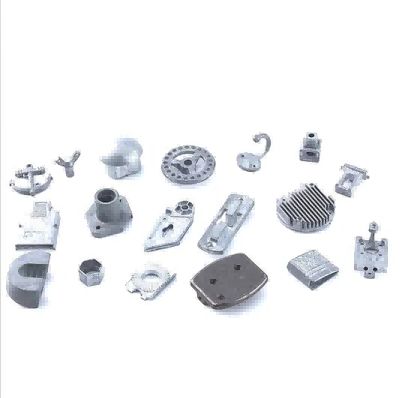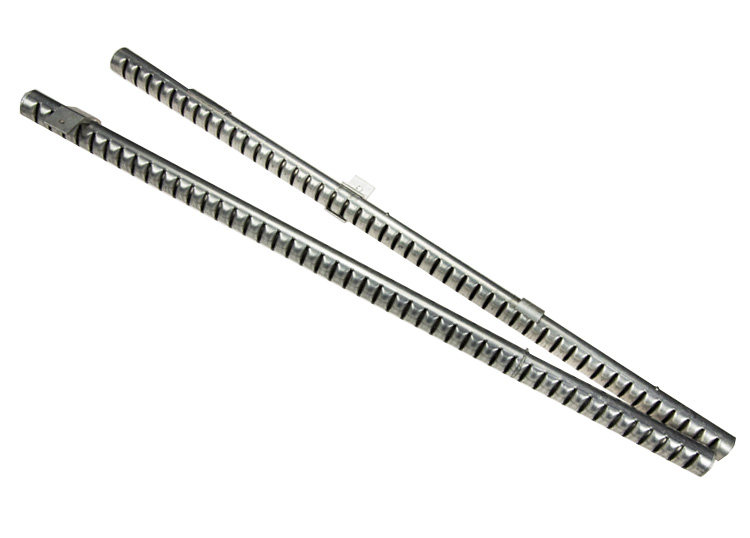
The global automotive industry is undergoing a structural shift toward electrification, which is directly driving an intensified focus on vehicle lightweighting. In electric vehicle (EV) design, mass reduction is a critical engineering requirement to offset the substantial weight of the energy storage system, thereby maximizing driving range and improving power-to-weight ratios. Aluminum stamping parts have become a foundational solution in modern EV architecture. Due to their favorable strength-to-weight ratio, high energy absorption capacity, and excellent corrosion resistance, stamped aluminum components are widely utilized across multiple vehicle systems. This technical analysis explores the specific applications and engineering parameters of aluminum stampings within contemporary electric vehicle design.
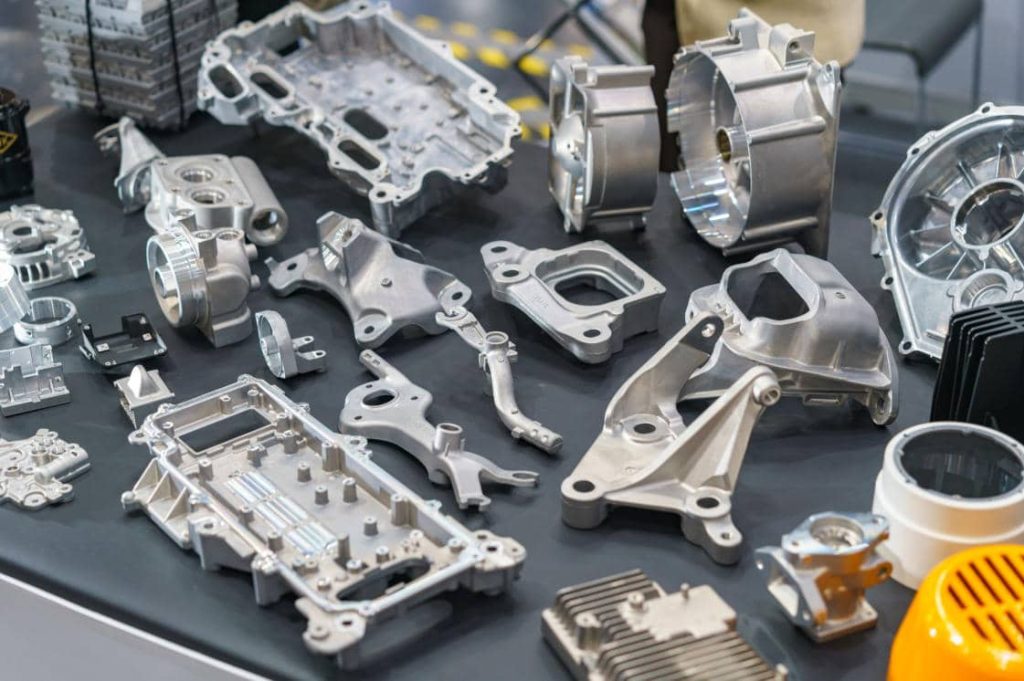
1. EV Battery Pack Aluminum Stamping Parts
The battery pack enclosure and its internal structural components are the fastest growing application area for aluminum stampings in today’s electric vehicle architectures. From a structural engineering point of view, the battery enclosure must be able to fulfill multiple roles: load-bearing member of the chassis, environmental sealing, and protection of cells from catastrophic mechanical intrusion during impact events.
- Battery Tray and Enclosure Cover: Large parts that require precise geometric tolerances to achieve absolute sealing integration. They are usually stamped from 5052 or 5754 aluminium alloys, which have good formability, deep-drawing properties, and excellent weldability.
- Battery Module Brackets and Cell Holders: Internal structural components are required to be highly dimensionally stable to retain cell matrices under high vibration and high G loading conditions.
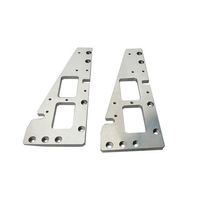
- Cooling Plate Supports and Reinforcement Plates: These combine structural reinforcement and thermal management paths using materials such as 6061 aluminum, where post-forming yield strength is important.
These particular grades of aluminum enable the battery pack to meet strict crash safety requirements while minimizing the gross vehicle weight.
2. Body-in-White (BIW) Structural Components
Modern EV body engineering increasingly relies on all-aluminum or multi-material steel-aluminum hybrid body-in-white (BIW) structures. Minimizing BIW mass lowers the vehicle’s center of gravity and reduces inertia, directly enhancing vehicle dynamics.
- Closure Panels: Door inner panels, hood inner panels, and tailgate inner panels are primary candidates for aluminum stamping. Stamping these complex, deep-drawn geometries requires alloys with optimal strain-hardening exponents.
- Structural Elements: Roof rails, wheel housings, side members, and front fenders are engineered to optimize energy dissipation during a collision.
By replacing conventional deep-drawn steel with stamped aluminum, structural engineers can increase torsional rigidity and optimize the vehicle’s structural resonant frequencies. This optimization prevents cabin booming and elevates overall NVH (Noise, Vibration, and Harshness) performance, which is particularly critical in EVs due to the absence of masking ICE (Internal Combustion Engine) noise.
3. Chassis System Aluminum Components
The chassis system is directly responsible for the ride, handling and safety parameters of the vehicle. For the design of EVs, the chassis must resist higher static loads due to the mass of the battery and hold the suspension geometry accurately.
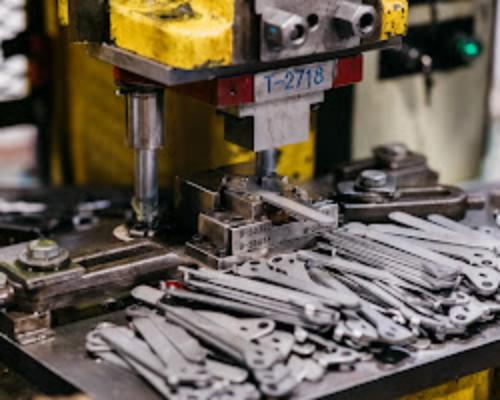
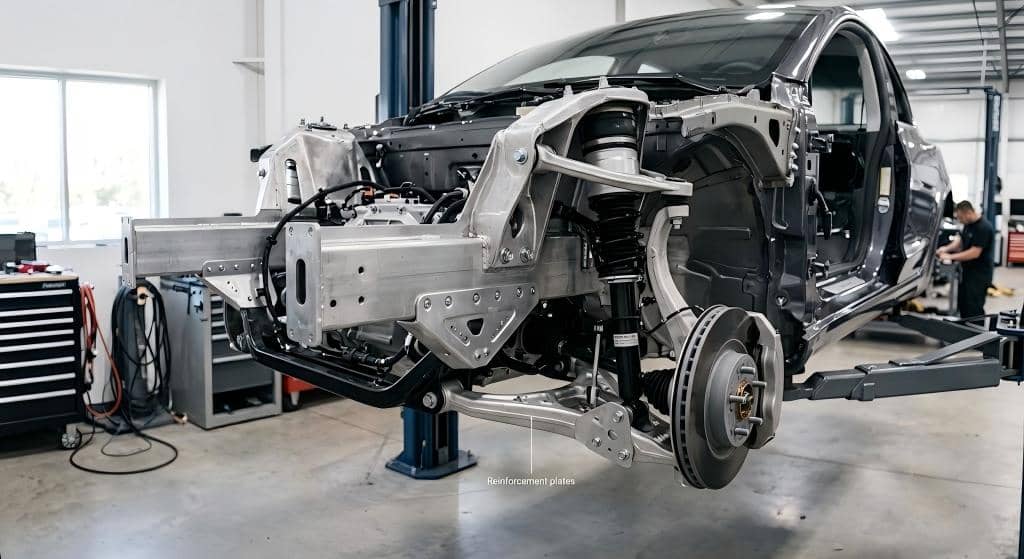
- Suspension Brackets and Control Arm Reinforcement Plates: These parts endure continuous cyclic loading and high stress concentrations. Stamped aluminum components replace heavier cast iron or forged steel alternatives.
- Cross Members and Subframe Reinforcements: These components bridge major structural nodes of the vehicle, managing lateral and longitudinal forces.
- Underbody Protection Plates: Positioned beneath the battery pack, these stampings require high impact resistance to protect against road debris and ground strikes.
The primary engineering benefit here is the reduction of unsprung mass. Lowering the unsprung-to-sprung mass ratio allows the suspension system to respond more rapidly to road irregularities, improving tire-to-road contact and mechanical grip. Furthermore, the inherent corrosion resistance of aluminum ensures long-term structural integrity without heavy anti-corrosion coatings.
4. Electric Drive Unit (EDU) & Motor System Brackets
While large electric motor and inverter housings are predominantly manufactured via high-pressure die casting, the integration of the Electric Drive Unit (EDU) within the vehicle subframe requires numerous structural and electrical stamping interfaces.
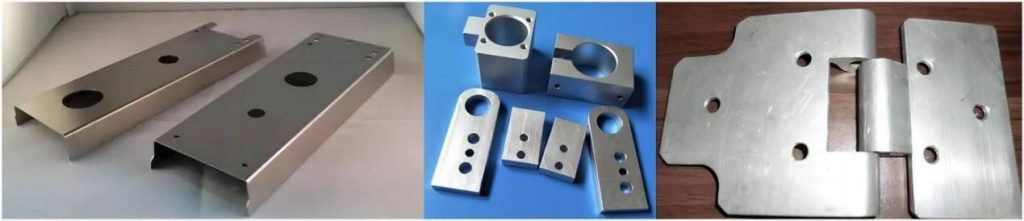
- Motor Mounting Brackets and Inverter Brackets: These structural components must withstand high torque-reaction forces and isolate high-frequency driveline vibrations.
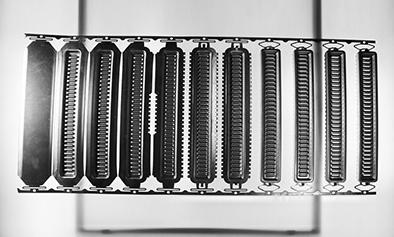
- Busbar Holders, Cable Fixing Plates, and Shield Covers: These parts secure internal electrical routing and provide electromagnetic shielding.
These components demand precision stamping to maintain strict dimensional tolerances. This precision is essential to guarantee accurate alignment within the tight packaging constraints of the powertrain layout. Additionally, the high thermal conductivity of aluminum assists in local heat dissipation away from the operating electronics.
5. Thermal Management System Stamping Parts
Thermal management systems in EVs are far more complex than in internal combustion vehicles – because they must manage the temperature of the battery pack, power electronics and cabin all simultaneously, to maintain their maximum operating efficiency.
- Cooling System and Radiator Supports: Stamped brackets locate and secure low-temperature radiators and chillers.
- Condenser Brackets and Compressor Mounting Plates: These parts support the air conditioning and heat pump mechanical infrastructure.
- Heat Shields: Formed aluminum sheets are utilized to isolate thermal zones, protecting sensitive electronic control units from heat localized in power electronics or braking systems.
Aluminum is chosen for these applications because it combines excellent thermal conductivity with low mass and high resistance to chemical degradation from coolant exposure.
6. High Voltage (HV) Electrical Systems
The high-voltage architecture of an EV (typically operating between 400V and 800V+) necessitates components that guarantee absolute structural reliability and electrical safety.
- Busbar Brackets and HV Cable Brackets: Aluminum stamping parts secure heavy-gauge wiring and solid copper/aluminum busbars throughout the vehicle chassis.
- Fuse Mounting Plates and Power Electronics Covers: These enclosures shield critical distribution blocks and circuit protection devices.
- Charging Socket Reinforcements: Structural stampings reinforce the vehicle frame around the charge port interface to withstand repeated mechanical insertion forces.
Strict adherence to tight tolerances in the manufacture of these components avoids mechanical wear on insulation materials. The absence of magnetic properties of aluminum also avoids inductive heating with high alternative or direct current flows, thus ensuring electrical safety.
7. Interior & Exterior Aluminum Stamping Parts
Beyond the primary load-bearing structures, aluminum stamping parts are extensively deployed in passenger cabin structures and exterior surfaces to capture secondary weight savings.
- Interior Structures: Seat brackets, seat frames, center console brackets, and instrument panel (IP) reinforcements utilize stamped aluminum to achieve up to a 40% mass reduction compared to steel baselines while maintaining required crash load pathways.
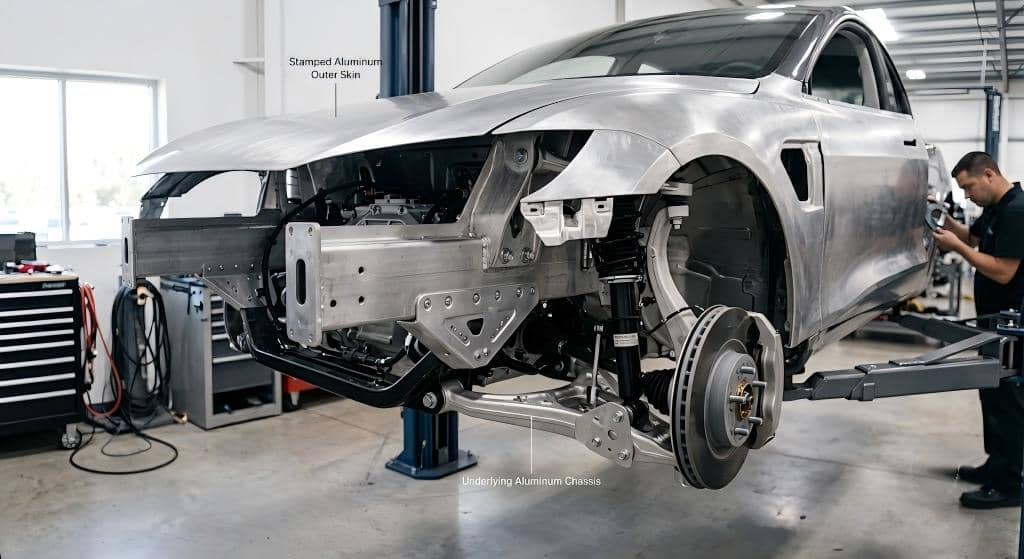
- Exterior Skin and Reinforcements: High-end EVs utilize stamped aluminum sheets for outer skin panels, including the roof panel, hood, and fenders. These parts require advanced stamping presses and precise springback compensation in the die design to ensure flawless surface quality and tight gap-and-flush alignments.
Material Selection & Benefits Summary
The following matrix synthesizes the specific material allocations and primary engineering metrics across the discussed vehicle systems:
| EV System | Typical Aluminum Stamping Parts | Key Material Grades | Primary Benefit |
| Battery Pack | Battery tray, enclosure covers, cell holders, cooling plate supports | 5xxx series (5052, 5754), 6xxx series (6061) | Crash safety optimization & mass reduction |
| BIW & Exterior | Door/Hood/Tailgate inners, roof rails, wheel housings, fenders, roof panels | 5xxx series, 6xxx series (6016, 6111) | High torsional rigidity & NVH optimization |
| Chassis | Suspension brackets, cross members, underbody protection plates | 6xxx series (6061, 6082) | Reduced unsprung mass & high corrosion resistance |
| E-Drive & HV System | Motor/Inverter brackets, busbar holders, shield covers, cable brackets | 1xxx, 3xxx, 5xxx series | Thermal conductivity, non-magnetic properties & precision |
Technical FAQ
Q1: Why is aluminum stamping preferred over steel for structural EV components?
A1: Aluminum stampings provide a mass reduction of about 40% to 50% over conventional steel components of equal structural performance. This reduction in weight in EV design directly counteracts the mass of the battery pack, optimizing the vehicle’s driving range. Aluminum alloys also exhibit good specific energy absorption. This enables engineers to design crush zones that effectively absorb the kinetic energy of impacts.
Q2: What are the main challenges when executing aluminum stamping in automotive production?
A2: Aluminum has a lower strain-hardening exponent and lower elongation properties than deep-drawing steels and hence is more prone to tearing and wrinkling during tight-radius forming. There is also a significant springback after the die is opened. To make this process automatic, the tool design must be backed up by accurate finite element analysis (FEA) so that the springback can be compensated and the final parts meet the tight dimensional tolerances.
Q3: How do material grades differ between an exterior panel and a structural chassis stamping?
A3: Exterior panels (for example, hoods or fenders) are generally made of 6xxx series alloys such as 6016 or 6111, which provide good distinctness of image (DOI) after painting and strain-hardening during the paint-baking process to increase dent resistance. Conversely, structural chassis stampings use higher-strength 6xxx series alloys such as 6082 or 6061, or ductile 5xxx series alloys like 5754, which are chosen for yield strength, fracture toughness, and energy absorption rather than surface appearance.