The global aluminum industry is currently experiencing a period of extraordinary volatility in March 2026. Geopolitical disturbances in the Middle East are impairing traditional supply chains and fabricating capacities, leading to extreme volatility in aluminum prices as well as internal aluminum premium rates. The report will present a technical analysis of the varied structural shifts occurring in the aluminum market due to various logistic constraints, acceptance, and underdependency on plastic raw materials. It will also discuss the regulatory impact of the Carbon Border Adjustment Mechanism.
Strategic Significance of Aluminum Production in the Middle East
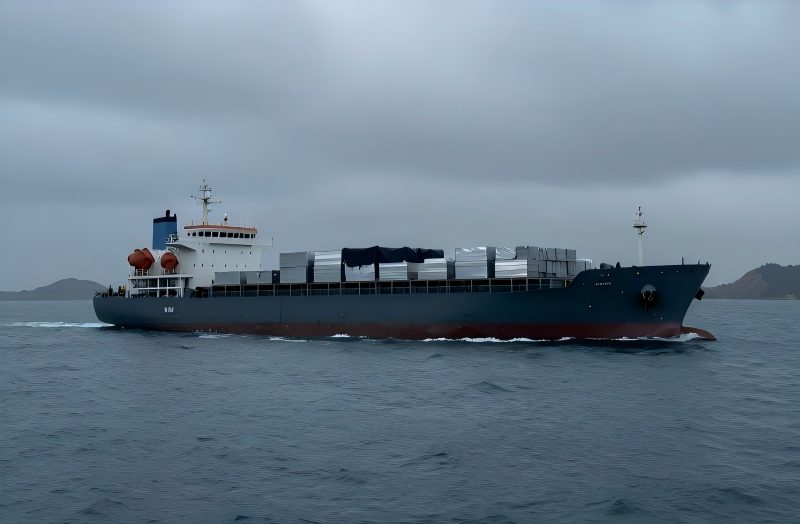
The Middle East also possesses about 9% of the world’s primary aluminum. The United Arab Emirates is home to plants Electrical Global Aluminium (EGA), among Aluminium Bahrain (Alba) and Qatar’s Qatalum. These are also some of the most productive smelter hubs. Bauxite and alumina must be brought into these locations regularly from other nations here too so that, in response, the aluminum ingots are shipped off to European, Asian, and North American markets.
The Hormuz Aluminum chokepoint is named, because in the Strait of Hormuz, there exists the only maritime passage of these producers. Since the early part of 2026, that region has witnessed increased military activity and partial blockade took place in the process; surprisingly, insurance premiums for cargo vessels skyrocketed by over 300%, and the whole lot of major shipping lines had to put themselves at a standstill in the Persian Gulf.
Supply Disruptions of Alumina and Force Majeure
Aluminum is a product of a continuous electrochemical process that requires a constant supply of alumina (Al2O3). In the Middle East, smelting firms have no bauxite mines in their own countries and purchase bauxite from abroad, mainly from Australia, India, and Guinea.
In March 2026, the maritime blockade, however, has taken a heavy toll on alumina supplies by proclamation of Force Majeure. Smelters are threatened with “potline freeze” when alumina shipments cannot reach the threatened ports of Jebel Ali or Khalifa; potline freeze is the solidification of the bath, damaging resistant brick and other major equipment. To prevent this, producers are beginning technical curtailments much earlier than usual, here planned to curtail the world production of primary aluminum by some 450,000 tons in 1Q 2026.
Aluminum Price Gains on Global Exchanges
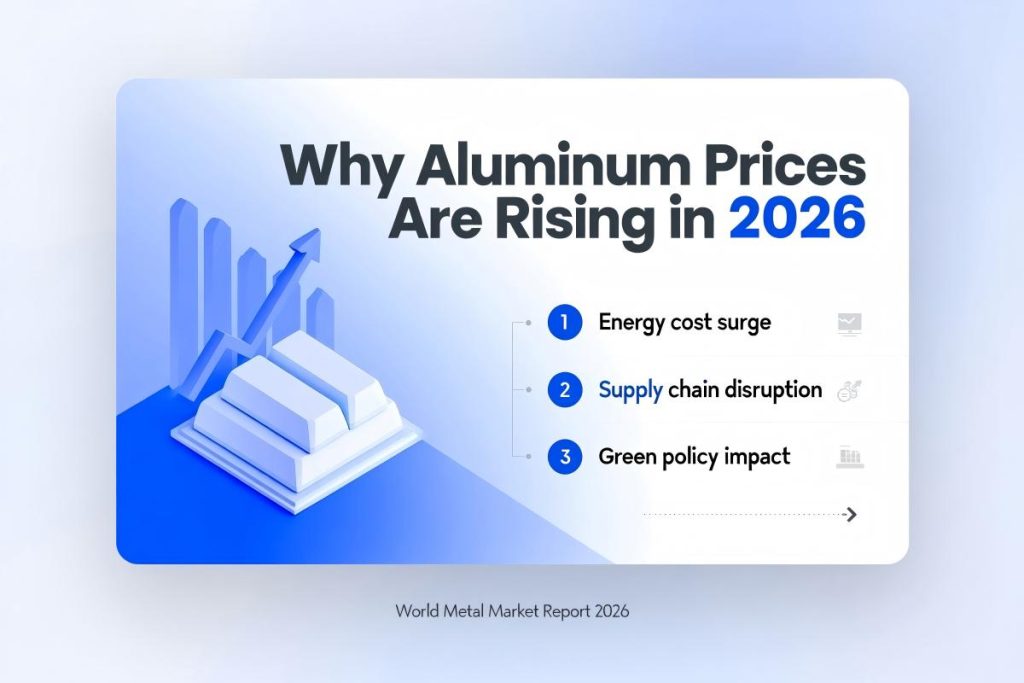
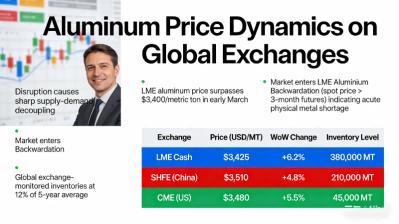
Disruption has completely severed supply-demand fundamentals from their long-held union, thereby forcing aluminum to break the $3,400 per metric ton threshold on the London Metal Exchange in early March.
Market Backwardation and Inventory Levels
The condition of an LME Aluminium Backwardation has arrived on the market with the front-end (cash) price being higher than the three-month futures price. This technical setup is symptomatic of acute shortages in physicals that can be made available immediately. Low inventories at the global exchanges have emerged as a mere 12% of the five-year average, thus giving no cushion for any further shocks akin to the existing supply situation.
| Exchange | Price (USD/MT) | WoW Change | Inventory Level |
| LME Cash | $3,425 | +6.2% | 380,000 MT |
| SHFE (China) | $3,510 | +4.8% | 210,000 MT |
| CME (US) | $3,480 | +5.5% | 45,000 MT |
Regional Aluminum Premium Variations
The aluminum premium represents the additional cost paid over the LME benchmark price to cover physical delivery, duty, and local scarcity.
- Main Japanese Portfolio (MJP): In Asia, the quarterly premium for Q2 2026 has been settled at $220/MT, a 25% increase from the previous quarter, reflecting the difficulty of sourcing metal from the Persian Gulf.
- European Duty-Paid Premium: In Rotterdam, premiums have reached $450/MT. European consumers are increasingly reliant on high-cost alternatives as Middle Eastern supply, which typically accounts for 20% of EU imports, remains inaccessible.
The Carbon Border Chain Adjustment Mechanism and Green Aluminum Premium (GAP)
In 2026, the formal beginning of the barebone European Union Carbon Border Adjustment Mechanism (CBAM) financial liabilities will be governed. This policy does not provide a fixed amount but rather charges the foreign-imported aluminum on the basic assumptions of embedded emissions.
Green Aluminum Premium (GAP) is currently the market COMEX. Aluminum that is manufactured using renewable power (hydro or solar) will have a premium of approximately $100 to $150/MT over small “brown aluminum” that will have come into the market by utilizing coal-fired power. Middle East producers relying on natural gas mostly stand in a “middle-class” emissions bucket (8−10 tons of CO2 per ton of Al). Consequently, the supply crisis has led to a situation where European buyers have been opting for availability over carbon footprints in response to the disruption of EU industrial decarbonization goals.
Impact on Downstream: Electric Vehicle Battery Casings and Infrastructure
There is significant stress on the automotive and energy sectors in an environment of expensive aluminum.
1. Battery Tray Demand for EV cells
Aluminium use per vehicle for modern electric vehicles is 190 kg, while for the battery tray, 6xxx series aluminum alloys are an indispensable utilization by manufacturers. The cost from raw materials for the standard battery tray in 2026 up by 18 percent over 2025. As a result, manufacturers now have increased considerations for optimizing the wall thickness designs and enhancing the use of recycled aluminum materials, wherever necessary.
2. Artificial Intelligence Data Centers & Grids
Operating capacity increases for AI data centers requiring more aluminum busbars and liquid-cooling heat sinks. Aluminum-coated high-voltage transmission lines play an important role because of their excellent conductivity characteristics and lightweight properties. The current price increase is likely to push a 12% hike in the capital costs associated with global grid infrastructure modernization projects during 2026-2027.
The Evolution of Recycled Aluminium Synergy
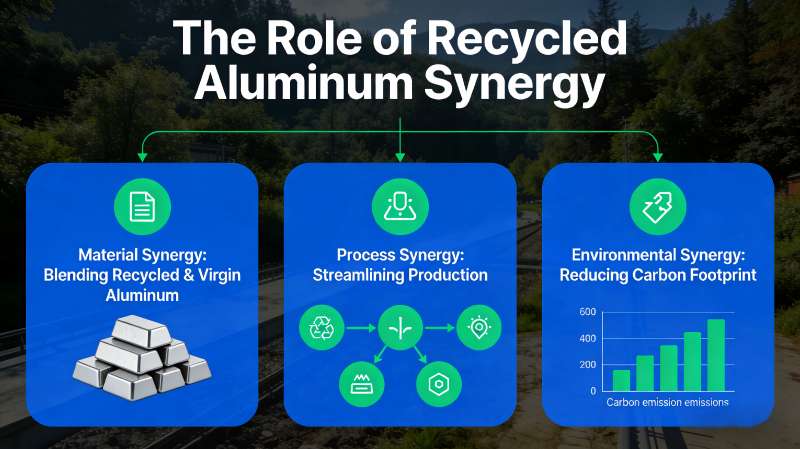
The recycling sector keeps growing through recent years in the backdrop of sustainability-driven actions headquartered strategically on the necessity of using secondary aluminum resources. Amazingly, only 5% of the energy required for primary smelting is needed for secondary aluminum production and such emissions are reduced by 95%. The growing circular-economy model led by the aluminium industry drives the residues out of landfills.
The spirit of recycling the allied market has a synergy of about 15,000 graduating researchers, only to be surrounded by a non-competitive share of the market by the solar sector, with the mattes of zirconium and graphite for the atomic industry in place. In 2026, advanced robotic sortation technologies will reach commercial maturity with X-ray Fluorescence (XRF) and Laser-Induced Breakdown Spectroscopy (LIBS). The technologies enable the separation of scrap of wrought and cast aluminum with great precision, which should produce high grades of alloys to be used in the aerospace and automotive industries as a substitute for primary metal. The problem of transit in the Middle Eastern region warrants this change in order to protect the levels of industrial production.
Structural Shifts in the Global Aluminum Market
The aluminum market in 2026 shows two main economic factors that result in its current market condition. The combination of Hormuz Aluminum Chokepoint risks, the CBAM implementation, and the reduction of worldwide stockpiles has established a minimum price level for the market.
Recovery of the structure depends basically on two parameters, the amelioration of safe maritime navigation in the Persian Gulf and a fast-track of the base metals melting capacity in replacement regions such as Indonesia and Brazil. The industry will continue to witness high aluminum premiums and a deepening practice of integration with recycled metals until these conditions hold firmly.