As the global EV industry moves into the 800V ultra-fast charging era, battery systems have to deal with more current and heat building up faster. In this situation, the Battery Thermal Management System (BTMS) has gone from being a supporting module to being a key factor in competition.
Three big problems face traditional heat dissipation parts, which are often made of multi-piece welded structures:
- Excessive weight
- Coolant leakage risks at welded joints
- Limited compatibility with high-precision automated production
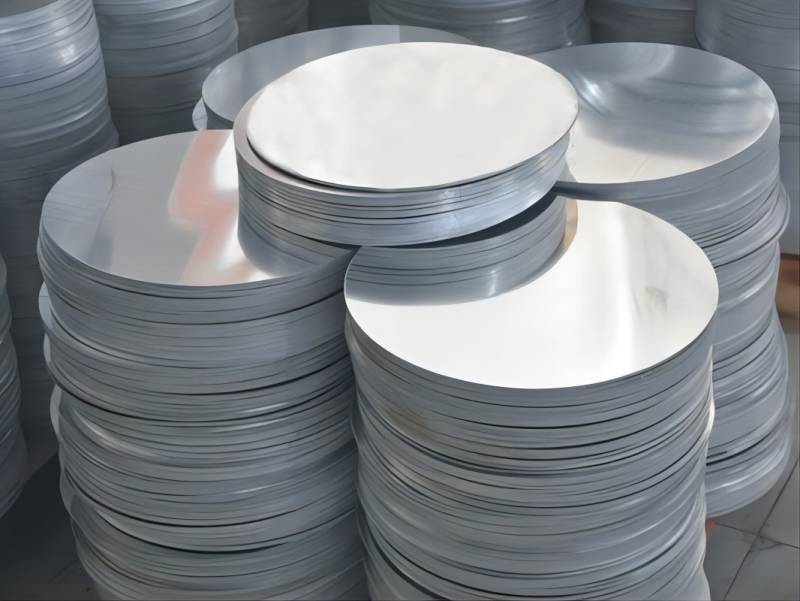
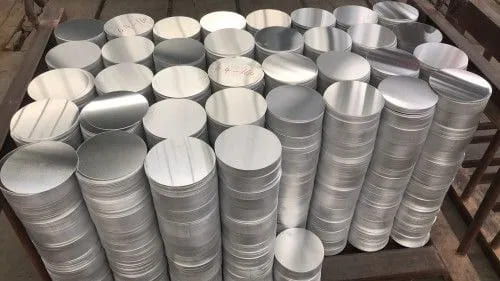
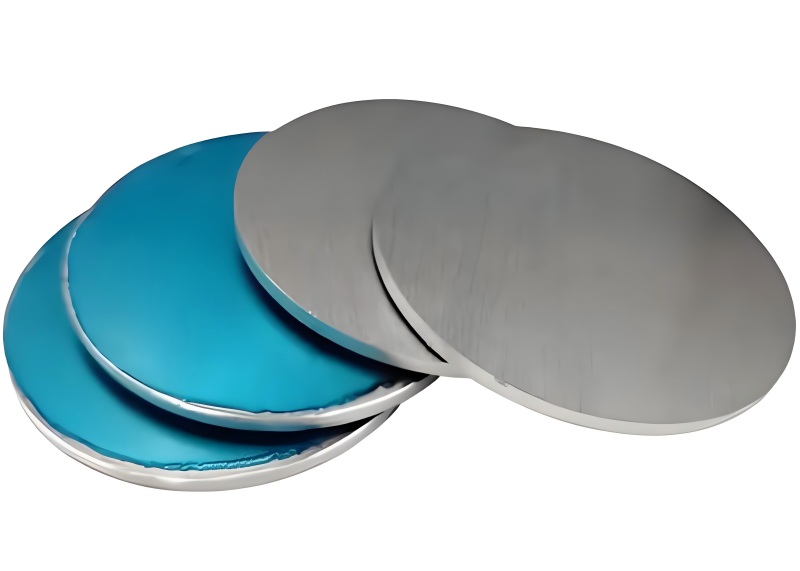
To overcome these limitations, aluminum circle for EV applications has emerged as a critical structural material. Through one-piece deep drawing forming, aluminum discs eliminate multiple weld seams, significantly improving reliability in high-pressure liquid cooling environments.
For manufacturers who know a lot about working with precision aluminum, EV-grade aluminum circles are no longer just raw materials. They are engineered solutions that combine material science, forming technology, and rules for car compliance
Why Aluminum Circles Are Ideal for EV Thermal Management?
1. Thermal Conductivity and Alloy Selection
Heat transfer efficiency is central to BTMS performance. Aluminum offers an optimal balance of conductivity, weight, and corrosion resistance.
| Alloy Series | Thermal Conductivity (W/m·K) | Key Characteristics |
| 1xxx Series (e.g., 1050) | 220–230 | Ultra-high conductivity, lower strength |
| 3xxx Series (e.g., 3003-H14 Aluminum) | 160–190 | Balanced conductivity & corrosion resistance |
| 6xxx Series (e.g., 6061-T6) | 160–180 | Structural strength & machinability |
1xxx alloys are great for transferring heat, but 3003-H14 aluminum is often better for battery thermal management aluminum applications because it is more resistant to corrosion and stronger mechanically. This is especially important in liquid cooling plate systems that are exposed to glycol-based coolants.
2. Deep Drawing Performance and Structural Integrity
A defining advantage of deep-drawing aluminum disc components is their ability to undergo integrated forming. During deep drawing:
- The aluminum circle transforms into a cup or housing structure.
- Weld seams are minimized or eliminated.
- Structural continuity reduces coolant leakage risk.
The structure must be fine-grained (ASTM 6 or finer). Controlled recrystallization makes sure that the elongation is even and stops cracking or orange peel effects from happening during stamping.
By cutting down on weld joints by up to 40%, manufacturers make long-term sealing much more reliable during high-pressure cooling cycles.
3. Lightweighting and EV Range Extension
Lightweighting remains central to EV engineering. Aluminum components can reduce system weight by approximately 30% compared to traditional steel assemblies.
For a mid-size EV battery pack, a 15 kg reduction in thermal system weight may translate into:
- 2–3% extended driving range
- Improved acceleration efficiency
- Lower energy consumption per kilometer
In the competitive EV market, even marginal efficiency gains can create significant commercial advantages.
Core Technical Specifications for Automotive-Grade Aluminum Circles in 2026
To meet evolving automotive standards, EV-grade aluminum circles must satisfy increasingly stringent parameters.
| Technical Parameter | Recommended 2026 Standard | Engineering Value |
| Alloy Temper | 3003-H14 / 6061-T6 | Balance of ductility & structural strength |
| Thermal Conductivity | 160–230 W/(m·K) | Supports high-rate 800V charging heat flux |
| Thickness Tolerance | ±0.02 mm | Compatible with robotic precision stamping |
| Grain Size | ASTM Grade 6 or finer | Prevents cracking during deep drawing |
| Surface Finish | Burr-free, oil-controlled | Ensures defect-free forming |
Precision thickness tolerance (±0.02 mm) is particularly vital for automated production lines, ensuring consistent deformation behavior during high-speed stamping.
Key Application Scenarios in EV Systems
1. Battery Housing Structures
Aluminum circles are widely used in cylindrical battery module bases and lower housing assemblies. Integrated forming improves sealing performance while maintaining mechanical durability under vibration and thermal cycling conditions.
2. Liquid Cooling Plates
In high-performance EVs, Liquid Cooling Plate systems rely on precision-formed aluminum discs that serve as foundational layers for microchannel machining.
Advantages include:
- High thermal conductivity
- Excellent braze compatibility
- Uniform microchannel formation
Pre-coated aluminum surfaces further enhance corrosion resistance and bonding reliability.
3. Inverter and Power Electronics Heat Sinks
Power electronics that work with an 800V architecture make a lot of heat in small areas. Aluminum circles are used as base plates for heat sinks. They provide stable thermal conduction while keeping the dimensions accurate for mounting semiconductor modules.
Sustainability and Compliance in 2026
1. Green Aluminum and Carbon Footprint Reduction
Recycled aluminum is becoming more popular as carbon norms become stricter around the world. Recycled aluminum may reduce energy consumption by 95% compared to primary aluminum.
Low-carbon footprint materials are increasingly needed to satisfy:
- EU Carbon Border Adjustment Mechanism (CBAM)
- OEM sustainability procurement standards
For brands of EVs to the consumer with environmental consideration, sourcing low-carbon materials enhances supply chain transparency.
2. Automotive Certification Standards
A sound EV-certified aluminum supplier should ensure conformity with the requirements:
- Standard for a quality management system in the automotive industry.
- Full traceability of the raw materials.
- Compliance with surface treatment procedures (anodization, anti-corrosive coatings).
Cutting without burrs and precise finishing of the surface are no longer electives; they are a preeminently requisite for EV parts that safeguard life.
The decision to make a specific aluminum circle appropriate for electric vehicles in 2026 for the future beyond holds consequences for battery safety, system efficiency, and competitive advantage in the rapidly changing world of mobility.
Frequently Asked Questions (FAQ)
1: Why is 3003 used more than 1050 in cold plates for EV’s?
The 3003 alloy underwent some change in corrosion properties, maintaining its strength parameters and conductivity values while chilling in the name of acceptability. It is enough because even while the finest increment in anticipatory conductivity considers only how long your glycol-based coolant system will last.
2: How do grain sizes affect the deep-drawing properties?
The effect of particle size on deep drawing properties is:
Fine grain sizes (e.g., ASTM 4-6) reduce fracture risk, also preventing orange peel surface marring, and this definitely promotes work into uniformity and structure reliability.
3: What are the factors affecting the 2026 aluminum coil price?
Some of these factors include:
- Supply chain localization trends
- Global ingot prices
- Energy prices
- Carbon compliance